

You might find yourself frustrated by knee pain going down stairs. This specific type of pain is often distinct from the discomfort you feel climbing stairs or walking on flat ground. Your knee endures unique stress during descent. Understanding what causes this pain is the crucial first step. This understanding leads to effective relief and lasting solutions for your knee. This guide helps you understand why your knee hurts and how to find relief from this pain. You can stop this pain in your knee.
Key Takeaways
Knee pain when going down stairs is common. It often comes from issues like runner’s knee, arthritis, or weak muscles. Your kneecap may not move correctly.
You can find quick relief for knee pain. Use the RICE method: Rest, Ice, Compression, and Elevation. Over-the-counter pain medicine also helps.
Long-term fixes include physical therapy and exercises. Strengthen your leg and hip muscles. This helps your knee move better and reduces pain.
Good shoes and lifestyle changes support knee health. Wear stable shoes with good cushioning. Eating healthy foods and taking certain supplements can also help.
See a doctor if your knee pain does not get better. Also seek help if you have swelling, cannot stand on your leg, or see signs of infection.
Understanding Knee Pain Mechanics
Increased Joint Stress During Descent
Descending stairs places unique demands on your knee. You might notice your knee pain going down stairs feels different from climbing. This is because the mechanics change significantly.
Patellofemoral joint stress (PFJS) during stair negotiation, both up and down, is much higher than walking on flat ground. This stress can be 2–4 times greater. Your knee experiences increased joint moments and higher contact forces. When you go down stairs, your muscles work differently. The roles of your muscle pairs reverse compared to going up. This means your body must control gravity, not just overcome it.
Note: Individuals with knee osteoarthritis (OA) often show a smaller knee joint range of motion during descent. They may not absorb impact well with their knee joint. Their ankle joint might work harder to compensate.
Role Of Quadriceps And Patella
Your quadriceps muscles are vital for controlling your knee. All four quadriceps muscles work to control and slow down knee joint flexion. This action is crucial when you lower your body down each step. The rectus femoris, one of your quadriceps, also helps control hip extension.
If your quadriceps muscles are weak, especially the vastus medialis, your knee stabilization can suffer. This makes your knee more vulnerable to pain during descent. Your kneecap, or patella, glides in a groove at the end of your thigh bone. Proper tracking of the patella is essential. Any issue with this tracking can lead to significant pain.
Common Pain Locations And Sensations
Knee pain often appears in specific areas when you go down stairs. You might feel pain around or behind your kneecap. This is a common sign of patellofemoral issues.
Sometimes, the pain feels sharp. Other times, it is a dull ache. You might also experience a grinding or popping sensation in your knee. This can indicate cartilage problems. The pain can also occur on the outside of your knee, suggesting IT band issues. Understanding where you feel the pain helps pinpoint the cause. This knowledge guides you toward the right solutions for your knee.
Common Causes Of Knee Pain Going Down Stairs
Many different issues can cause knee pain going down stairs. You need to understand these causes to find the right solution for your knee. Each condition affects your knee in a specific way during descent.
Patellofemoral Pain Syndrome (Runner’s Knee)
Patellofemoral Pain Syndrome (PFPS), often called Runner’s Knee, is a very common cause of knee pain. This condition involves improper tracking of your kneecap (patella) in its groove on your thigh bone. When you go down stairs, your kneecap can rub against the bone.
This creates friction and pain. Your quadriceps muscles help control your kneecap’s movement. Weakness or imbalance in these muscles can lead to poor tracking. This makes descending stairs particularly painful.
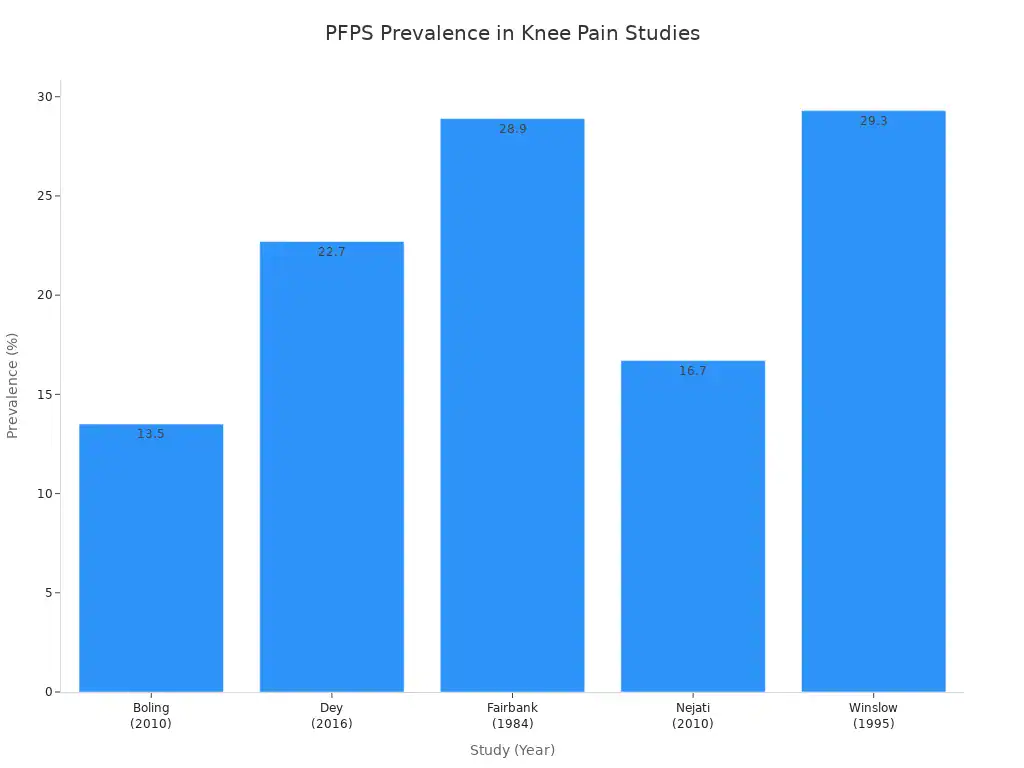
Many people experience this type of knee pain. Studies show a significant number of individuals report pain with activities like going down stairs.
Study (Year) | Population | Diagnostic Criteria (including stair pain) | Prevalence | Notes |
|---|---|---|---|---|
Boling (2010) | US Naval Academy personnel (mean age unknown, range 18–25) | Retropatellar pain with activities like ascending/descending stairs, plus specific palpation pain. | 13.5% (Point prevalence) | Case definition included pain with ascending/descending stairs. |
Dey (2016) | UK community sample (mean age 30) | Anterior knee pain associated with activities like ascending or descending stairs, running, and squatting. | 22.7% (Annual prevalence) | Case definition included pain with ascending/descending stairs. |
Fairbank (1984) | 13–17 year-old students in UK (mean age 14.7) | Questionnaire asking if knees hurt coming downstairs. | 28.9% (Annual prevalence) | Diagnostic criteria specifically included pain coming downstairs. |
Nejati (2010) | Female athletes in Iranian Sports Olympiad (mean age 21.6, range 15–35) | Non-traumatic anterior knee pain aggravated by descending or ascending stairs, squatting, or prolonged sitting. | 16.7% (Point prevalence) | Pain aggravated by descending/ascending stairs was a key criterion. |
Winslow (1995) | University female ballet dancers, USA | Pain in front of or under the knee cap with 3 out of 5 criteria, including during stair climbing. | 29.3% (Point prevalence) | Stair climbing pain was one of the diagnostic criteria. |
Osteoarthritis Of The Knee
Osteoarthritis (OA) is a degenerative joint disease. It causes the cartilage in your knee to wear away. This condition is a major source of knee pain, especially during activities like going down stairs. Cartilage breakdown leads to stiffness, swelling, and pain.
Many people with knee osteoarthritis experience a burning pain. This happens particularly when descending stairs. Inflammation and ongoing joint wear cause this. Your knee must absorb significant impact and control your body weight with each step. This strains your joint structures. Your quadriceps muscles also undergo increased eccentric loading. They lengthen under tension to control movement. This can cause fatigue, irritation, or pain in an already compromised knee.
People typically develop knee osteoarthritis as they age. A study on difficulty descending stairs in individuals with knee osteoarthritis included participants with an average age of 62.2 years. Other research reported a mean participant age of 68.7 years, with an age range of 57.0–78.0 years.
Iliotibial (IT) Band Syndrome
Iliotibial (IT) Band Syndrome causes pain on the outside of your knee. Your IT band is a thick band of tissue running from your hip to your shin. It helps stabilize your knee. When you go down stairs, your knee flexes. This can cause the IT band to rub or compress against the bony prominence on the outside of your thigh bone. This irritation leads to pain.
Historically, experts believed the IT band slid back and forth over the lateral femoral epicondyle. This caused friction and inflammation. Pain is most common on the lateral aspect of the knee.
It is most intense at 30 degrees of knee flexion. More recent research suggests the IT band is tethered to your distal femur. It does not slide as much as once thought. Instead, when your knee flexes past 30 degrees, the band compresses against the lateral femoral epicondyle. This causes irritation of the fat tissue between the band and the bone. This makes ITBS a compression syndrome.
Chondromalacia Patellae
Chondromalacia patellae is a condition where the cartilage under your kneecap softens and deteriorates. This is a primary pathological change. This softening makes your kneecap less able to handle the stress of movement. When you go down stairs, your kneecap moves against your thigh bone. This movement can cause significant pain due to the damaged cartilage. This condition is often seen in people with anterior knee pain.
Muscle Strains And Weakness
Weak or strained muscles around your knee can contribute to knee pain going down stairs. Your quadriceps, hamstrings, and glutes are crucial for knee support and control.
Quadriceps weakness: Weak thigh muscles reduce support for your knee joint. This increases strain during stair use.
Age-related muscle loss: This specifically affects your quadriceps and glutes. It reduces joint support and control. This increases discomfort when you step down.
Strengthening focus: Building strength in your quadriceps, hamstrings, and glutes helps support your knee. This improves control during stair use. Weakness in these areas contributes to pain.
Research shows knee pain during stair negotiation links to altered activity and weakness in your hip muscles. These muscles help stabilize your pelvis and leg.
Ligament Injuries
Ligament injuries can cause significant knee pain and instability. Your knee has several important ligaments. The anterior cruciate ligament (ACL) and meniscus are common injury sites. An ACL injury results in suboptimal kinematics. This leads to increased anterior tibial translation and internal tibial rotation.
During stair ascent and descent, ACL-deficient knees show a more varus and internally rotated tibial position. They also have higher anterior tibial translation and flexion angles. This causes combined anterior and rotatory instability. This is especially true with muscle fatigue or poor neuromuscular control.
Meniscus tears can cause knee pain and swelling. This pain tends to worsen when you put weight on your knee, such as during stair descent. Ligament injuries, including ACL tears, lead to knee instability and pain. This is particularly true during weight-bearing movements like descending stairs.
Immediate Knee Pain Relief
When you experience sudden knee pain going down stairs, you need quick ways to manage the discomfort. These immediate steps can help reduce your pain and prevent further irritation.
Rest And Activity Modification
Rest is crucial for your knee when it hurts. You should avoid activities that worsen your pain. Doctors recommend a RICE (Rest, Ice, Compression, and Elevation) regimen for one to two weeks after an acute knee injury diagnosis. This involves resting your affected knee to allow healing.
You must avoid activities that stress your knee until inflammation subsides. Returning to activities too soon increases your risk of slow healing or worsening the injury.
For knee osteoarthritis, if joint swelling and pain persist for more than two hours after exercise, you need at least a temporary modification of your exercise program. A period of rest from high-impact activity, such as running, is recommended. You can gradually increase activity as your symptoms allow. The ‘Protection Phase’ for acute knee injuries, lasting the first two weeks, focuses on controlling pain and swelling. You protect healing tissues during this time. This phase includes a significant rest period and gentle, pain-free movements. You also perform gentle range of motion exercises and isometric strengthening.
Ice Therapy (RICE Method)
Applying ice to your knee helps reduce swelling and pain. This is a key part of self-care for knee pain. The optimal duration for icing an injury is 15-20 minutes per session.
Breaks between icing sessions are crucial to prevent skin damage or increased pain. For acute injuries (within three days), you should apply ice for 20 minutes on and 30 to 40 minutes off. For chronic conditions like tendonitis and osteoarthritis, icing for 20 minutes several times a day can be very effective.
Compression And Elevation
Compression and elevation also help manage swelling in your knee. You can use an elastic bandage to gently compress your knee. This helps reduce fluid buildup. Elevating your leg above your heart also encourages fluid drainage away from your knee joint. These simple steps work together to provide knee pain relief.
Long-Term Fixes And Treatment
Long-Term Fixes and Treatment
Achieving lasting relief from knee pain—especially when walking downstairs—requires a comprehensive, root-focused approach. Long-term improvement depends on strengthening key muscles, improving flexibility, and supporting overall knee health.
Physical Therapy and Targeted Exercises
Physical therapy is one of the most effective long-term treatments for knee pain. A licensed physical therapist will create a personalized program that targets your unique weaknesses and movement imbalances. For conditions such as patellofemoral pain syndrome (PFPS), physical therapy typically lasts one to two months. Research shows that an 8-week program significantly improves pain, functional ability, and overall quality of life compared to no treatment.
Therapists commonly use exercises that strengthen and improve control around the knee, including:
- Goblet Squats: Build compound strength in the quadriceps, glutes, and core to improve squat mechanics, knee stability, and lower-body power. Perform 10 repetitions for 2 sets.
- Forward Step-Ups: Strengthen the quadriceps and glutes to improve stair performance. Step up with the affected leg, then lower slowly with control. Perform 10 repetitions for 2 sets.
- Lateral Step-Overs: Enhance coordination and eccentric quadriceps control—critical for safe stair descent. Step laterally up, bring the opposite leg up, and step down to the other side. Complete 10 repetitions for 2 sets.
Strengthening the Quadriceps and Glutes
Strong quadriceps and gluteal muscles are essential for knee stability, impact absorption, and proper movement mechanics. These muscles play a particularly important role during stair descent.
Key quadriceps functions include:
- Knee extension: Primarily produced by the vastus medialis and vastus lateralis
- Hip flexion: Assisted by the rectus femoris
- Knee stabilization: Crucial for controlling kneecap position and preventing injury
- Controlled descent: Eccentric muscle activation cushions impact when moving downhill or downstairs
Combining hip strengthening with traditional quadriceps exercises yields significantly better long-term results than quadriceps strengthening alone. Studies show that integrated hip-and-knee programs lead to greater improvements in pain, function, and stair performance at 3, 6, and 12 months.
Patients with PFPS often present with:
- Weak hip abductors and external rotators
- Delayed or reduced gluteus medius activity during stair tasks
Strengthening these areas—along with the quadriceps—has been shown to produce superior pain reduction and functional gains within 4–8 weeks.
Helpful exercises include:
- Split Squats: Work the quadriceps, glutes, and hamstrings while stretching the hip flexors, improving overall lower-body strength and stability.
- Kneeling Leg Extensions: Require no equipment and are ideal for those with balance limitations. They strengthen the quadriceps and enhance knee stability when performed with core engagement and controlled backward leaning.
Improving Flexibility and Range of Motion
Adequate flexibility in the hamstrings and hip flexors is vital for reducing knee stress. Tight hip flexors limit hip extension, alter femur alignment, and increase strain on the kneecap—especially during activities like stair climbing. When hip mobility is limited, the knee compensates, which can contribute to PFPS.
Stretching the hip flexors reduces tension, improves alignment, and decreases the load on the knee. Improved hamstring flexibility also enhances efficiency during movement, particularly during stair descent, which requires significant eccentric control.
Dynamic stretches—such as the half-kneel hamstring stretch paired with an opposite hip-flexor stretch—promote balanced mobility and smoother knee tracking.
Proper Footwear and Orthotics
Appropriate footwear can significantly reduce knee pain by improving foot alignment and decreasing abnormal forces on the knee. Look for shoes with:
- Good stability to maintain neutral foot alignment
- Adequate cushioning to absorb shock
- Low heel height, as heels 3 cm or higher increase patellofemoral joint stress and quadriceps load during stair descent
Individuals with flat feet, overpronation, or other foot mechanics issues may benefit from arch-supportive shoes or custom orthotics. Custom orthotics help correct biomechanical problems by:
- Controlling calcaneal eversion
- Limiting excessive tibial internal rotation
- Reducing stress on the knee joint
- Improving lower-limb stability
These adjustments can lessen strain on muscles such as the abductor hallucis and tibialis anterior, indirectly supporting healthier knee mechanics.
Lifestyle Adjustments for Knee Health
Daily habits play a powerful role in long-term knee comfort. Certain dietary approaches may help reduce pain and inflammation:
- Limit saturated fats and emphasize omega-3 polyunsaturated fats (e.g., fish oil), which can decrease joint pain and stiffness
- Consider a low-carbohydrate diet, shown in 2020 to reduce pain and oxidative stress in knee osteoarthritis
- Adopt a Mediterranean diet, rich in whole foods, fruits, vegetables, and legumes—associated with lower inflammation markers and improved pain scores
For individuals with knee osteoarthritis and obesity, a hypocaloric diet can reduce symptoms, improve function, and potentially slow disease progression.
Helpful supplements include:
- Vitamin D: May reduce chronic widespread pain
- Magnesium (400–800 mg/day): Supports neuromuscular health and may reduce central sensitization
- Curcumin: Offers anti-inflammatory and antioxidant benefits
- Glucosamine sulfate (Rotta formulation): May improve pain and function in knee osteoarthritis, typically after 3 months of consistent use
When To Seek Medical Help
You need to know when your knee symptoms require a doctor’s visit. Sometimes, your body gives you clear signals that you need professional medical attention. Do not ignore these signs.
Persistent Or Worsening Pain
You should see a doctor if your knee pain does not get better. If the pain is bad enough to need painkillers often, you need to get it checked. This means more than a few times each month. Also, if your knee feels stiff, swollen, or cannot move fully, you should seek medical advice. If your pain gets worse over time, you need to see a doctor. This is especially true if it stops you from doing daily activities or exercising.
Swelling Or Instability
You need immediate medical help for certain types of swelling or if your knee feels unstable. If you suspect an acute knee injury, especially a ligament tear, meniscus tear, or bone injury, get help right away. Swelling that appears right after an injury means a significant bleed.
This suggests damage to your bones or ligaments. If swelling happens 24 to 36 hours later, it could be a slower bleed or fluid buildup. Red flag symptoms like night pain, weight loss, fevers, or a history of cancer also mean you need a specialist. If your knee feels warm with fevers and sweats, especially without an injury, it could be an infection.
Inability To Bear Weight
If you cannot put weight on your knee without a lot of pain, you need urgent medical care. This could mean a serious injury like a fracture or a bad ligament tear. Intense pain when you try to stand on your leg signals a serious knee injury. This includes ligament tears, fractures, or meniscus injuries.
If your knee pain is so bad that walking is unbearable, or if you feel faint or unsteady, stop putting weight on it. Seek medical attention right away. If your knee looks deformed or you hear a “pop” during an impact, go to the emergency room. These signs point to a fracture or severe ligament injury.
Signs Of Infection
You must seek immediate medical help if you see signs of a knee infection. Look for sharp, constant pain in your knee. This pain often gets worse with movement. Your knee may appear swollen and red.
It will also feel warm or hot. If you have a fever or chills, the infection might be spreading. You may find it hard to bend or straighten your knee fully. This is due to inflammation and pain. Knee sepsis is very serious. It needs quick treatment to prevent long-term damage.
Knee pain going down stairs is a common issue, but you can treat it effectively. Identifying the specific cause of your knee pain is crucial for effective treatment. You have learned about immediate relief methods and long-term fixes for your knee. These strategies help manage your pain. Be proactive in managing your knee health. Consult a healthcare professional for personalized advice and diagnosis. You can regain pain-free mobility on stairs.