You might feel self-conscious about your large calves. Many people ask, “why are my calves so big?” It is a common frustration. Your calf size comes from many factors. These include your muscle development, fat distribution, and genetics. Understanding your calf is key. This blog will explore the reasons behind a large calf. We will also provide actionable solutions to manage your calf appearance. You can learn about your calf muscle.
Key Takeaways
Your calf size comes from many things. These include your muscles, fat, and genes.
You can make your calves smaller. Do exercises like walking and swimming. Eat a healthy diet to lose fat.
Your genes play a big part in your calf size. They decide your muscle type and bone shape.
Some health problems can make your calves big. These include swelling or fat disorders.
You can talk to experts about your calves. They help you understand your body and set goals.
Your Calf Size: Muscle vs. Fat
Assessing Muscle Mass in Calves
You need to understand if your large calf comes from muscle or fat. Assessing your calf muscles helps you know this. Many people worry about their calves. Gold standard methods like Magnetic Resonance Imaging (MRI) or Computed Tomography (CT) measure muscle mass accurately.
These are very precise. Dual-energy X-ray absorptiometry (DXA) and bioelectrical impedance analysis (BIA) are also common in clinics. BIA is reliable and works like DXA for diagnosing muscle loss.
For a simple check, measure your calf circumference. This is a non-invasive and inexpensive way. A calf circumference less than 34 cm for men or 33 cm for women can indicate lower muscle mass. This method is useful when you have limited resources.
Identifying Fat Distribution on Calves
Your calf can hold fat in different ways. Subcutaneous fat sits right under your skin. This fat can make your calves look bulky. It can hide your calf definition. Another type is intramuscular adipose tissue (IMAT).
This fat is inside your lower leg tissue. You can assess IMAT by measuring its density. Lower density means higher IMAT levels. High IMAT reduces the area of your contractile tissue. It can change how your muscle fibers align. This decreases your force capacity. IMAT may also harm blood flow to your calf. Elevated intramuscular fat links to mitochondrial dysfunction.
Some people have a condition called lipedema. This causes abnormal fat distribution in the lower legs. Lipedema fat feels soft, lumpy, or nodular. It does not firm up with exercise. This fat often affects both calves symmetrically. You might see a distinct fat ‘collar’ just above your ankles. This contributes to a wide calf appearance. Lipedema fat can also be painful or tender to touch.
Body Composition’s Impact on Calf Appearance
Your overall body composition greatly affects your calf size. Calf circumference shows your peripheral muscle mass. Your Waist-Calf Circumference Ratio (WCR) connects to your body composition. A higher WCR means more fat mass and less skeletal muscle mass. This includes visceral fat. The proportion of muscle and fat in your calf directly influences its size. It also affects how people see your lower leg compared to other body parts.
The shape of your calf depends on its calf muscles. The gastrocnemius and soleus are key. Genetics influence the size and shape of these muscles. They affect your fiber proportions. A larger gastrocnemius muscle gives you more shapely calves. This shows how your body composition impacts your calf’s visual appearance.
Genetic Factors: Why Are My Calves So Big?
You might wonder, “why are my calves so big?” Often, the answer lies in your genetics. Your genes play a huge role in shaping your body. They influence your natural calf muscles and how fat distributes. This means your calf size can be something you inherit. Your inherited muscle fiber makeup and bone structure also contribute.
Inherited Muscle Structure and Fiber Type
Your genetics determine your muscle structure. They also decide the types of muscle fibers you have. This directly impacts your calf size and shape. You have different types of muscle fibers.
Fast-twitch fibers help with powerful, quick movements. Slow-twitch fibers are better for endurance. Your body’s mix of these fibers is largely inherited. This mix affects how your calves respond to exercise. For example, if you have more fast-twitch fibers, your calf muscles might grow larger with certain types of training.
Scientists have found specific genetic markers linked to larger calf muscle structure. These include genes like Atp2a1, Tmod4, Lmod3, Ryr1, and Mybpc2. These genes influence how your muscle develops. Your genetics also explain differences in fiber type makeup between people.
For instance, if you have the ACTN3 RR genotype, you likely have more type IIx fibers. These are a type of fast-twitch fiber. Another gene, the ACE D allele, links to a higher proportion of type I fibers.
These are slow-twitch fibers. Specific single nucleotide polymorphisms (SNPs) like PDE3A, PDE6C, and other variants also connect to having more type I muscle fibers. This shows how your genetics are a primary factor in your calf growth. They influence the size, shape, and fiber composition of your calf muscles.
Genetic Predisposition to Calf Size
Your genetics can give you a natural tendency for a certain calf size. This means you might have bad calf genetics if you want smaller calves. Or you might have great genetics if you want bigger ones. Studies show that the heritability of calf muscle cross-sectional area can be between 0.18 and 0.23.
This means a significant portion of your calf size is due to your genes. This heritability can change with age and sex. For example, leg lean muscle mass heritability is lower in older people. It is higher in younger people.
Scientific research, even in animals like cattle, supports this idea. Genes like LCORL and NCAPG influence calf size at birth and adult height. The LCORL gene also affects height and fetal growth in humans. This suggests a broad genetic role in growth across different species.
These findings show a genetic predisposition to specific calf sizes. Variations in these genes directly impact growth and size. So, if you feel like you have bad calf genetics, there is a scientific basis for that feeling. Your genetics undeniably influence your overall muscle growth and size.
Factors like muscle fiber types and muscle belly size are part of your genetic makeup. While training can change fiber types, your genetics set their initial composition. This contributes to the inherent size and shape of your calf. This is why some people struggle with bad calf genetics when trying to change their calf appearance.
Ethnic Background and Calf Shape
Your ethnic background can also play a role in your calf shape and size. Different ethnic groups often show variations in average calf measurements. For example, Black African/Caribbean children often have larger calf circumferences. This is true when compared to other ethnic groups. These differences in calf circumference become more noticeable as children get older. This is especially true after age 9 or 10.
This increased difference in calf size after age 10 might link to different timings of puberty. Black African/Caribbean children tend to start puberty earlier. This trend of greater ethnic variation in calf size often continues into adulthood.
So, if you are asking, “why are my calves so big?”, your ethnic background could be one of the factors. It is another example of how genetics influence your body’s natural shape and size, including your calf.
Lifestyle and Habits Affecting Calf Development
Your daily life choices greatly influence your calf size. Your movement patterns, exercise routines, and even your shoe choices can shape your calves. You can understand how these habits affect your lower legs.
Exercise Routines and Calf Growth
The exercises you do directly impact your calf development. To grow your calves, you need specific training. You can try exercises like the Single-Leg Calf Raise on a Leg Press. This helps you find and fix muscle imbalances. It also uses a full range of motion.
You sit in a leg press, place the ball of one foot on the sled, and press up. Hold for two seconds at the top and bottom. Do 3 sets of 12 to 20 reps. Jump Rope is another great exercise. It builds explosive power and helps calf growth through repeated movements. You jump and swing the rope, landing on the balls of your feet. Do 30 seconds on, 30 seconds off for 3 to 4 rounds.
You should also think about your foot position. Small changes in how you push through your feet can change muscle activation. Vary your rep schemes from 10 to 25 reps. Alternate between volume and strength days. Do not avoid heavier weights on strength days. Add plyometric movements like jumping, sprinting, or hill runs. These build power in your calves. Here are more exercises you can do:
Exercise | Equipment | Sets | Reps | Rest |
|---|---|---|---|---|
Seated Calf Raise | Bench | 3 | 10-15 | 30-60 sec |
Standing Calf Raise | Box | 3 | 30 | 30-60 sec |
Leg Press Calf Raise | N/A | 3 | 15-20 | 30-60 sec |
Donkey Calf Raise | Box | — | 50 | 30-60 sec |
Daily Activities and Calf Engagement
Your everyday activities also engage your calf muscles. Walking, standing, and climbing stairs all work your calves. If you do activities like intense cycling, your calf muscles can become larger. These regular movements contribute to your overall calf size and strength.
Footwear Choices and Calf Muscle Activation
Your shoe choices can change your calf. Wearing high heels often can remodel your leg muscle tendons. The medial gastrocnemius muscle can shorten by about 12.9%. Your Achilles tendon stiffness can also increase by 16.7%. For every 1,000 steps you take in high heels each day, your Achilles tendon stiffness increases by 9.2%.
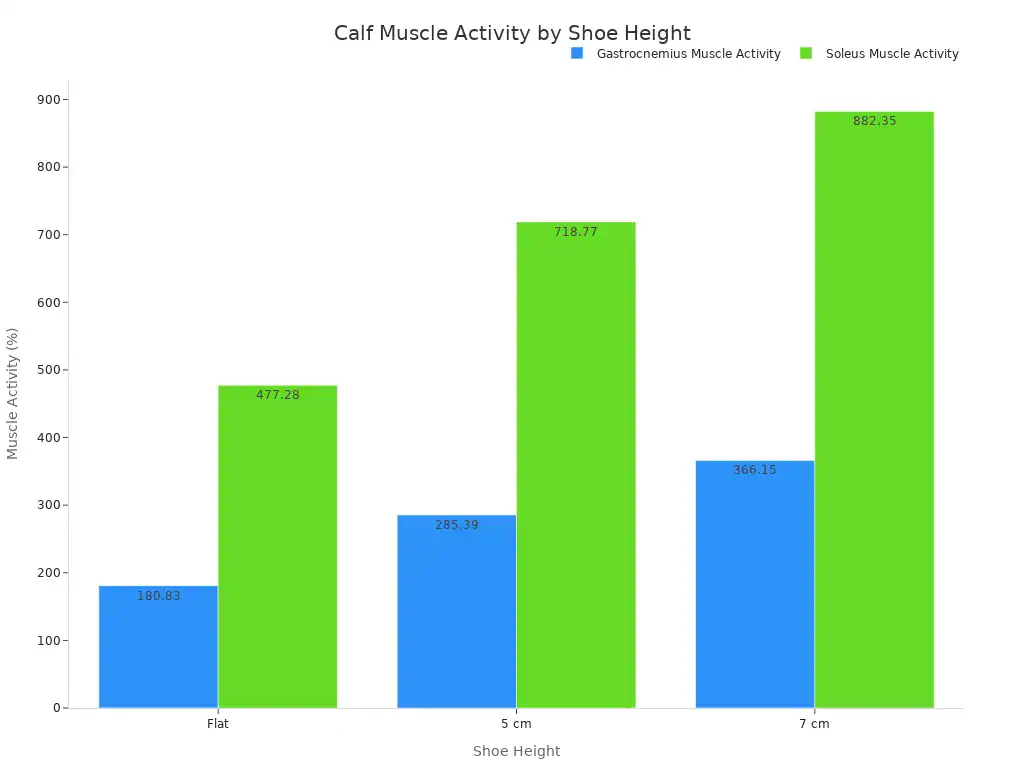
High heels make your ankle point down more. This causes your calf muscle fibers to work at shorter lengths. To make up for less force at these shorter lengths, your calves shed muscle units. This results in shorter overall muscle fiber lengths. Look at how different heel heights affect muscle activity:
Shoe Height | Gastrocnemius Muscle Activity (%) | Soleus Muscle Activity (%) |
|---|---|---|
Flat | 180.83 ± 61.78 | 477.28 ± 209.21 |
5 cm | 285.39 ± 122.25 | 718.77 ± 380.50 |
7 cm | 366.15 ± 193.73 | 882.35 ± 509.93 |
You can see significant differences between flat and 7 cm shoes.
Medical Conditions and Other Causes of Large Calves
Sometimes, medical conditions can explain why your calf looks larger. These conditions often involve fluid retention or specific fat disorders. You should understand these possibilities. They can significantly impact your calf size.
Swelling Conditions: Lymphedema and Edema
Fluid buildup can make your calf appear much larger. Edema is swelling caused by excess fluid trapped in your body’s tissues. Lymphedema happens when your lymphatic system does not work correctly. This system drains fluid. Both conditions cause swelling in your lower legs.
For lymphedema, you might notice specific signs. You see swelling on the top of your foot. Your toes and foot can look square. Your toenails might have a “ski jump” shape. Your skin can thicken. You cannot pinch a skin fold on the base of your second toe. This is a positive Kaposi-Stemmer sign. In later stages, you might see rough, cobblestone-like skin. This swelling is usually not painful. It has mild pitting. Lack of pitting is common in stages II and III lymphedema.
For edema, your doctor will ask about your history. They will ask about the swelling’s location, symmetry, and how it changes during the day. You might feel aching, pain, or heaviness. Your skin can show changes like staining or dermatitis. Pitting is important for diagnosis. Swelling from venous disease usually worsens when you stand. It improves when you elevate your legs. Doctors use duplex ultrasound to check your veins. They also look for other causes. This helps them understand your calf swelling.
Lipedema: A Fat Disorder Affecting Calves
Lipedema is a chronic fat disorder. It causes abnormal fat accumulation, especially in your legs. This condition often makes your calves disproportionately large. The fat feels soft and lumpy.
It does not respond to diet or exercise. You might notice a distinct fat “collar” just above your ankles. This creates a wide calf appearance. Lipedema fat can also be painful or tender to the touch. It affects both legs symmetrically.
Hormonal Influences and Weight Gain
Hormonal imbalances can also contribute to larger calves. Hormones regulate your metabolism and fat storage. Imbalances can lead to overall weight gain. This weight gain often includes increased fat deposits in your lower body. Conditions like hypothyroidism or polycystic ovary syndrome (PCOS) can affect your weight. This can make your calf size increase. Obesity is a general factor. It means you carry more body fat. This extra fat can distribute throughout your body, including your calves. This is another reason why are my calves so big.
Strategies to Manage and Reduce Calf Size
You can take practical steps to manage and reduce your calf size. These strategies focus on reducing fat and reshaping your muscles. You can achieve a leaner look for your lower legs.
Targeted Exercises for Calf Reduction
You can use specific calf exercises to reduce their size. These exercises focus on lengthening and toning your muscles. They do not aim for bulk. Consider low-impact activities. These activities can help you burn calories without overdeveloping your calf muscles.
Walking and Hiking: These activities are excellent for overall fitness. They engage your calf muscles in a balanced way. You build endurance without excessive muscle growth.
Swimming: Swimming is a full-body workout. It is gentle on your joints. It tones your muscles, including your calves, without adding bulk.
Yoga and Pilates: These practices emphasize flexibility and core strength. They lengthen your muscles. They improve your posture. This can make your calves appear more streamlined.
Elliptical Trainer: This machine provides a good cardio workout. It minimizes impact on your lower legs. It helps you burn calories and reduce overall body fat.
You should focus on higher repetitions with lighter resistance. This approach helps to tone your muscles. It does not encourage significant muscle hypertrophy. You can also incorporate bodyweight calf exercises. These include standing calf raises with controlled movements. You can also do seated calf raises. These help to define your calf without adding excessive size.
Dietary Adjustments for Overall Fat Loss
Your diet plays a crucial role in reducing your calf size. You need to reduce overall body fat. This includes fat stored in your calves. A study showed that combining dietary restriction with exercise significantly reduced body mass. It also reduced lower extremity adipose tissue, including in the calves. You can enhance fat loss in your calves and other body areas. You do this by adopting a balanced diet with controlled caloric intake.
Consider these dietary strategies for effective fat loss:
Keto Diet: This diet is high in fat, moderate in protein, and low in carbohydrates. It promotes ketosis. Your body burns fat for energy. This reduces overall fat stores. It helps slim areas like your calves. Focus on foods like avocados, nuts, seeds, fatty fish, olive oil, and non-starchy vegetables.
Low-Carb Mediterranean Diet: This diet emphasizes whole, unprocessed foods. It includes healthy fats, lean proteins, and vegetables. It limits carbohydrates. It is rich in anti-inflammatory foods. These foods support overall health. They can target stubborn fat areas like your calves. Key components include fresh vegetables, olive oil, lean meats (chicken, fish), nuts, and seeds.
Intermittent Fasting: This involves cycling between eating and fasting periods. When you pair it with a balanced diet, it helps regulate insulin levels. It improves your metabolic rate. This targets fat storage in your calves. During eating windows, focus on nutrient-rich foods. These include lean proteins, vegetables, whole grains, and healthy fats.
Plant-Based Diet with Controlled Carbs: This diet focuses on high-fiber, natural foods. These include fruits, vegetables, legumes, nuts, and seeds. It controls carbohydrate intake for fat reduction. This diet is lower in saturated fat. It promotes calorie control. This leads to steady fat reduction in areas like your calves. Recommended foods include quinoa, lentils, chickpeas, leafy greens, and berries.
You can also embrace a balanced diet. Incorporate complex carbohydrates like quinoa and brown rice for satiety. Include lean proteins like chicken, turkey, and tofu. These build muscle and burn more calories. Add healthy fats like avocados, nuts, and seeds for efficient metabolism. Optimize your calcium intake. Consume low-fat dairy products.
Stretching and Flexibility for Calf Appearance
Stretching and flexibility training can improve your calf appearance. Regular stretching helps to lengthen your calf muscles. This can make them look more elongated and less bulky. It improves your muscle elasticity and range of motion.
Research from 1970–1995, mainly animal studies, suggests that prolonged static stretching can create enough mechanical stress to increase muscle mass and strength. While these findings might apply to humans, especially in rehabilitation for muscle atrophy, more human studies are needed.
Some human studies have looked at short-duration stretch training over several weeks. Many show a significant increase in maximal strength from long-term static stretching. For example, one study saw a 6.4 ± 9.9% increase in calf muscle maximal strength within five weeks. Participants stretched twice a week for 6 × 5 minutes using a stretching board.
While some studies indicate stretching can increase muscle strength, the primary benefit for calf appearance is improved flexibility. This can lead to a more defined and less bulky look. You can make your calf appear leaner. Focus on stretches that target both your gastrocnemius and soleus muscles.
Standing Calf Stretch: Stand facing a wall. Place your hands on the wall. Step one foot back. Keep your heel on the ground. Lean forward until you feel a stretch in your back calf. Hold for 30 seconds. Repeat on the other side.
Seated Calf Stretch: Sit on the floor with your legs extended. Loop a towel around the ball of one foot. Gently pull the towel towards you. Keep your leg straight. Feel the stretch in your calf. Hold for 30 seconds. Repeat on the other side.
Downward-Facing Dog (Yoga Pose): This pose stretches your entire posterior chain. It includes your calves. Push your hips up and back. Keep your heels reaching towards the floor.
Regular stretching helps maintain muscle health. It improves blood flow. It can contribute to a more aesthetically pleasing calf.
Training Principles to Grow Calves Fast (or Reshape Them)
You might find it hard to grow your calf muscle. Many people struggle with calf development. Proper training can help you overcome this challenge. You can reshape your calves and achieve your goals.
Best Exercises to Grow Calves Effectively
To grow calves fast, you need effective calf exercises. You should use a full range of motion. Lower your heels below the step for a larger stretch. Squeeze your calves at the top and hold for 1-2 seconds. Progressive overload is key. Increase intensity by adding weight (5-10% weekly).
You can also use plyometric calf exercises like lunge jumps and jump rope. These improve strength and definition. For hypertrophy, aim for 6-12+ reps for 4-5 sets, at least twice per week. Higher rep ranges are often effective for calves. They increase time under tension.
You should slow down the eccentric phase of calf exercises. Hold the peak contraction. Emphasize the stretch at the bottom of the movement. This approach should be your default method for training calves.
Myoreps are highly recommended for calf training. They maximize effective reps. Calves are well-suited for myoreps. They have few limiting synergists. This leads to rapid local recovery. You can have short rest times, sometimes as low as 10 seconds between sets. This rapid recovery means your calf workout sessions can be short.
To target your gastrocnemius, use exercises with extended knees, like standing calf raises. This calf muscle responds well to explosive contractions and lower repetitions (8-12 reps) with heavy loads. For your soleus, perform exercises with bent knees, such as seated calf raises. This calf muscle responds best to higher repetition ranges and more time under tension.
Overcoming Stubborn Calf Growth
You might wonder how long does it take to grow calves. Your calf growth can seem stubborn. Variation, time under tension, and appropriate repetition ranges are key principles.
Avoid bouncing or jerking movements. This prevents your Achilles tendon from absorbing energy. It reduces tension on your calf muscle. While a full range of motion is best, adding partial repetitions at the end of a set can induce total fatigue. Incorporate two sessions per week for your soleus and two sessions per week for your gastrocnemius. Allow 48 hours of rest between sessions. This totals 2-4 grueling calf workouts per week for significant growth.
Avoiding Poor Workout Programming
Many people fail to properly train your calves. There is often an old-school mentality. Some believe training calves is unnecessary. They think calf muscles will benefit enough from other lower body training.
This does not put you in the best position. You need to directly load your calf region in your strength training program. Do not overlook this importance. You must directly train your calves to see results. Avoid using the same calf exercises, reps, and sets consistently. This prevents adaptation. You need to vary your calf workouts to keep your calf muscle guessing. This helps you grow calves fast.
Professional Solutions and Realistic Expectations for Calf Size
You might consider professional help for your calf appearance. These solutions offer ways to contour your calves. You also need to have realistic expectations. Your body’s natural shape, including your genetics, plays a big role.
Aesthetic Treatments for Calf Contouring
Several aesthetic treatments can change your calf shape. These procedures aim to contour your lower legs. You can discuss these options with a qualified medical professional.
Circumferential liposuction removes fat around your calf.
Ultrasound-assisted lipoplasty uses sound waves to break down fat.
Autologous fat grafting adds fat to certain areas for reshaping.
Selective neurectomy targets nerves to reduce muscle bulk.
Partial resection of the gastrocnemius muscle removes part of the muscle.
Calf implants (submuscular and subfascial) add volume to your calves.
Endoscopic fascial release loosens the tissue around your muscles.
Combined techniques use several methods together for best results.
Consulting Healthcare and Fitness Experts
You should talk to healthcare and fitness experts. They can help you understand your calf size. A doctor can rule out medical conditions. A physical therapist or certified trainer can assess your muscle development.
They can also look at your fat distribution. These experts consider your genetics and lifestyle. They create a personalized plan for you. They help you set achievable goals. This ensures you pursue safe and effective changes.
Embracing Your Natural Calf Size
You can also choose to embrace your natural calf size. This means accepting your body as it is. This choice offers many psychological benefits.
Body Acceptance: You learn to appreciate your own body. This reduces self-criticism.
Self-Esteem and Self-Worth: You recognize your value beyond physical looks. This builds a positive self-perception.
Challenging Societal Standards: You help fight unrealistic beauty ideals. This promotes self-love.
Building Resilience: You develop a positive mindset. This helps you resist societal pressures.
Cultivating Empathy and Compassion: You acknowledge every body’s uniqueness. This fosters an inclusive society.
Holistic Well-being: You prioritize overall health. This improves your mental well-being.
You now have a clearer picture of why your calves are so big. Diverse factors like genetics, muscle, fat, lifestyle, and medical conditions all play a role. Understanding the specific cause is your first step toward finding solutions. Focus on your overall health and well-being, not just aesthetics. Embrace your unique body. Make informed choices about your calf appearance.