You often see liver enzyme tests in routine health check-ups. These liver blood tests help you understand ast & alt results. AST (Aspartate Aminotransferase) and ALT (Alanine Transaminase) are key indicators of your liver health. These are liver enzymes primarily found in your liver cells.
When liver damage occurs, your liver releases these enzymes into your bloodstream. Did you know that 15% to 20% of people globally have abnormal liver enzyme levels? In Bangladesh, 21.6% showed elevated AST levels. This blog helps you understand ast & alt results and when to be concerned about your liver. You will learn what your liver blood test numbers mean.
Key Takeaways
AST and ALT are liver enzymes. High levels in your blood mean your liver might be hurt.
Many things can make these enzymes high. These include fatty liver, medicines, and alcohol.
The AST/ALT ratio helps doctors find out why your liver is hurt. A ratio of 2:1 or more often means alcohol-related liver disease.
Watch for signs of liver damage. These include feeling tired, dark urine, or swelling. See a doctor if you have these signs.
Always talk to a doctor about your liver test results. They can explain what the numbers mean and what to do next.
What Are AST and ALT
Defining Liver Enzymes
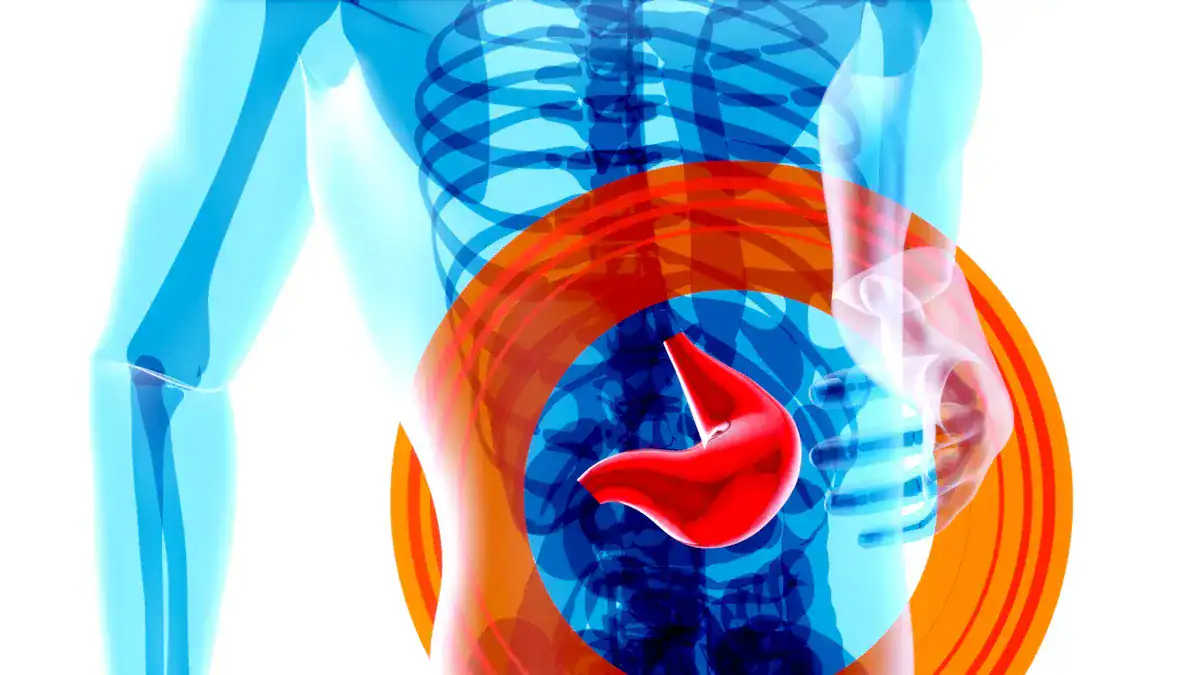
Your body has many enzymes. These are proteins that help chemical reactions happen. Aspartate Aminotransferase (AST) and Alanine Transaminase (ALT) are two important liver enzymes. They are mainly found inside your liver cells. When your liver cells are healthy, you find only low levels of these liver enzymes in your blood.
AST is an enzyme that helps change aspartate into oxaloacetate. This process is part of how your body makes energy. AST is in many parts of your body, like your liver, heart, and muscles. It acts as a general sign of liver damage. When liver cells get hurt, AST leaks out. This makes your ast levels go up in your blood. ALT is another enzyme. It helps change alanine into pyruvate. This reaction is a key part of how your body uses amino acids. Like AST, ALT needs vitamin B6 to work.
Understanding Normal Levels
Doctors use liver function tests to check your liver health. An ast blood test helps them see how your liver is working. You usually have low levels of ast and alt in your blood. Here are the typical normal range for liver function tests:
ALT: 7-56 units/L
AST: 5-40 units/L
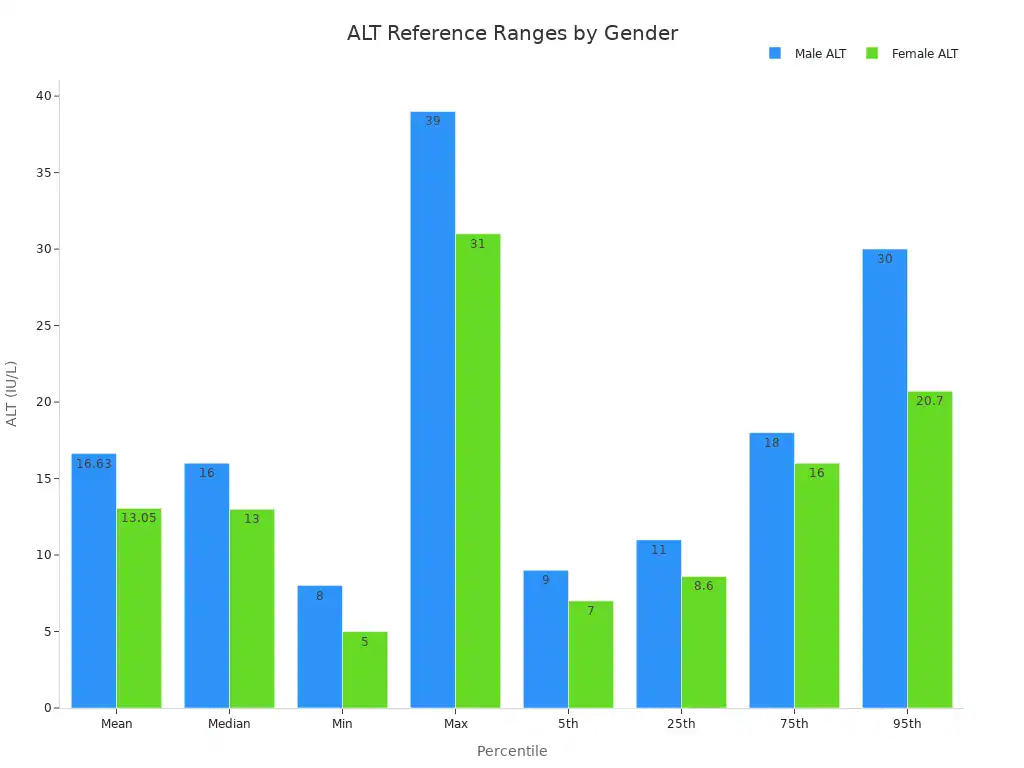
These numbers can change a bit. For example, the general range for ALT in adults is 4-42 units/L. For boys, the upper limit for ALT is about 30 IU/L. For girls, it can be lower, around 20-24 IU/L depending on age. For AST, the normal range is often 0-35 units/L. Girls usually have slightly lower ast levels than boys.
Percentile | Male ALT (IU/L) | Female ALT (IU/L) |
|---|---|---|
Mean | 16.63 | 13.05 |
Median | 16 | 13 |
Min | 8 | 5 |
Max | 39 | 31 |
5th | 9 | 7 |
25th | 11 | 8.6 |
75th | 18 | 16 |
95th | 30 | 20.7 |
Factors Affecting Ranges
Many things can affect your liver enzyme levels. Certain medicines can raise your ast levels and alt levels. For example, high doses of acetaminophen can harm your liver. Some natural products like kava or certain supplements can also be toxic to your liver. Medicines like some antibiotics or antifungals can also cause liver injury.
Your diet also plays a role.
Dietary Factor | Impact on AST/ALT Levels |
|---|---|
Alcohol (>3 drinks/day) + Obesity | Significantly increases ALT and AST. |
Obesity (men) | Stronger predictor of elevated serum ALT than alcohol. |
Obesity (women) | Alcohol is a stronger predictor of elevated serum ALT than obesity. |
Low-fat Diets | Can improve ALT and AST levels. |
Fast-food Diets | Can increase serum ALT. |
Vegetarian Diet | Linked to lower serum AST. |
Heavy alcohol drinking can raise alt levels. Eating a lot of fast food or foods high in simple sugars can also increase your liver blood tests results. On the other hand, low-fat or low-carbohydrate diets can help reduce these levels. A vegetarian diet is linked to lower ast levels. These factors show why your doctor looks at your full health picture when reviewing your liver blood tests.
Interpreting Elevated Liver Enzymes
What High Levels Indicate
When your liver blood tests show elevated enzyme levels, it often means your liver is under stress. These high ast and alt numbers tell you about liver damage, injury, inflammation, or stress on your liver. Your liver enzymes are usually inside your liver cells. When these cells get hurt, they release their contents, including AST and ALT, into your bloodstream. This makes your ast levels and alt levels go up.
Sometimes, an increase in ast and alt can also signal muscle damage. Your body has AST in other places besides your liver, like your muscles and heart. So, if you have muscle injury, your ast blood test might show higher levels. Doctors look at your liver function tests as a whole. If your AST and ALT are much higher than other markers like alkaline phosphatase (ALP) and bilirubin, it suggests a problem mainly with your liver cells. This is called a hepatocellular pattern of injury.
Common Causes of Elevation
Many things can cause elevated liver enzymes. The most common cause globally is fatty liver disease. This affects 25–51% of people with the condition. Fatty liver disease can be alcohol-related or non-alcohol-related. Metabolic syndrome, which includes high blood sugar, high blood pressure, being overweight, and high cholesterol, also commonly causes elevated liver enzymes.
Here are some specific causes of elevated liver enzymes:
Liver-related conditions:
Fatty liver disease (alcohol-related and non-alcohol-related)
Hepatitis (A, B, C, alcoholic, autoimmune)
Hemochromatosis (too much iron in your body)
Cirrhosis (permanent liver scarring)
Wilson’s Disease (too much copper in your body)
Ischemic Hepatitis or “Shock Liver” (lack of blood flow to the liver)
Medications and Toxins:
Certain medications, like cholesterol-lowering drugs (statins) and acetaminophen.
Herbal and vitamin supplements (e.g., chaparral, comfrey tea, iron, vitamin A).
Illicit drugs (cocaine, anabolic steroids).
Acute Viral Hepatitis: In cases of acute viral hepatitis, your ast and alt levels are often very high, typically 400 IU/L or more. If these levels go above 1000 IU/L, your doctor will check your PT/INR to see how well your liver is clotting blood.
You can also have elevated liver enzymes from conditions not directly related to your liver:
Muscle damage: This includes rhabdomyolysis (severe muscle breakdown), strenuous physical activity, or muscle diseases.
Heart conditions: A heart attack (myocardial infarction), acute coronary syndrome, or inflammatory heart disorders.
Other conditions: Thyroid disorders, celiac disease, hemolysis (red blood cell breakdown), and even heat stroke.
The AST/ALT Ratio
The ratio between your ast and alt levels gives your doctor important clues about the cause of your liver damage. Most liver cell injuries show a greater increase in ALT than AST. However, a specific ratio can point to certain conditions.
If your AST/ALT ratio is 2:1 or greater, it strongly suggests alcoholic liver disease. This is especially true if your gamma-glutamyl transferase (GGT) is also high.
Condition | Mean AST/ALT Ratio | Range (AST/ALT) | Mean AST (U/L) | Mean ALT (U/L) |
|---|---|---|---|---|
Nonalcoholic Steatohepatitis (NASH) | 0.9 | 0.3-2.8 | 66 | 91 |
Alcoholic Liver Disease (ALD) | 2.6 | 1.1-11.2 | 152 | 70 |
*Note: A ratio of < 1 suggests NASH, while a ratio of >= 2 strongly suggests ALD. The difference in AST/ALT ratios between the two groups was highly statistically significant (p < 0.000001).*
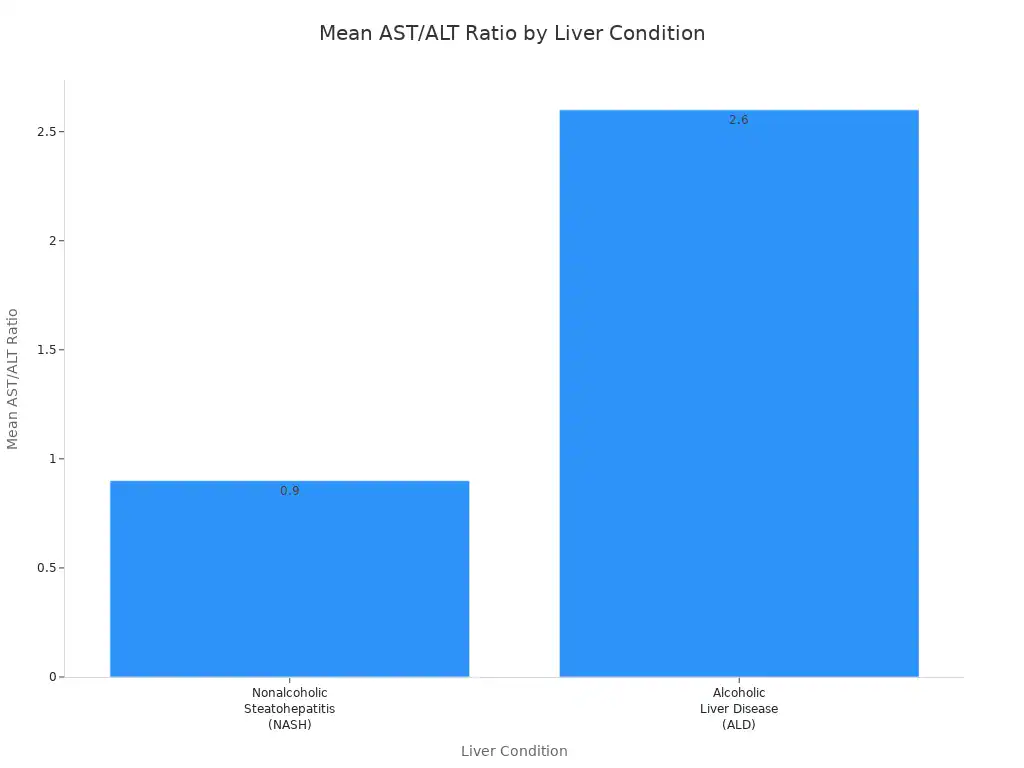
An AST/ALT ratio greater than 2:1 is very telling for alcoholic hepatitis, particularly if you have had recent alcohol exposure or advanced alcoholic liver disease. This ratio can also appear in acute toxicities, like an overdose of paracetamol, or in drug-induced hepatitis, especially when drugs harm the mitochondria in your cells.
In acute viral hepatitis, an AST/ALT ratio of 2.0 or higher can mean a very serious course and a poor outlook. While acute viral hepatitis usually has an AST/ALT ratio below 1.0, atypical cases, especially severe ones, can show a high AST/ALT ratio up to 2.0. This indicates a very poor prognosis. If your acute viral hepatitis is not getting better, this ratio will not decrease. Ratios of 2.0 or greater reflect immediate release of cellular proportions and a potentially severe outcome.
When your ALT is between 200 and 500 U/L and your De Ritis ratio (AST/ALT) is over 1.5, you have a forty-fold higher chance of your transaminase levels going above 1000 U/L within a day or two. In studies of acute viral hepatitis, people who recovered had AST/ALT ratios between 0.3–0.6. Those who did not survive had ratios between 1.2–2.3. This highlights the ratio’s role as a vital clue to your prognosis.
When to Act on Liver Enzyme Results
You might wonder when to worry about your liver enzyme levels. Understanding your liver blood tests is important. You need to know when to seek medical advice.
Symptoms of Liver Damage
Your liver often works hard without showing signs of trouble. However, your body can give you clues when liver damage starts. You might notice some early warning signs.
Fatigue: You feel tired often. Your liver struggles to filter toxins. This makes you feel generally unwell.
Frequent gassy sensation: You experience routine bloating and pressure. A damaged liver may not make enough digestive juices.
Confusion: You might feel brain fog or disorientation. Toxins build up when your liver does not work well.
Swelling in legs and ankles: Your feet and ankles might swell. A weak liver can cause fluid retention.
Dark urine: Your urine looks darker than usual. It can be brown, orange, or amber. This shows bilirubin buildup in your liver.
Pale stool: Your stools may become pale or clay-colored. This happens if your liver does not produce enough bile or its flow is blocked.
Loss of appetite: You might not feel like eating. Changes in metabolism or nausea can cause this.
Nausea: You feel sick to your stomach.
Discomfort or mild pain: You might feel this in the upper right side of your abdomen.
Unexplained weight loss: You lose weight without trying.
Vomiting: You throw up.
Some symptoms mean you need immediate medical help. These signs point to severe or advanced liver damage. You might have severe abdominal pain. You could vomit blood or pass black or bloody stools. This indicates internal bleeding. A high fever with shivering, shaking, dizziness, pain, or vomiting suggests a possible infection.
Confusion, disorientation, drowsiness, or not being able to wake up could mean hepatic encephalopathy. Enlarged blood vessels in your esophagus or stomach can burst. This causes serious bleeding. You need immediate medical attention for these issues.
Beyond AST and ALT: Other Liver Function Tests
Your doctor looks at more than just ast and alt levels. Other liver function tests give a fuller picture of your liver health. These additional liver enzyme tests help doctors understand what is happening.
Here are some common liver function tests you might have:
Alkaline phosphatase (ALP): This liver enzyme goes up with liver injury.
Gamma-glutamyl transferase (GGT): This liver enzyme also rises with liver injury.
Serum bilirubin: This measures bilirubin, a waste product. Your liver processes bilirubin.
Prothrombin time (PT): This test measures how fast your blood clots. Your liver makes proteins needed for clotting.
Albumin tests: Albumin is a protein your liver makes. Low levels can mean poor liver function.
Total protein test: This measures protein levels in your blood. Low levels can show suboptimal liver function.
Lactate dehydrogenase (LDH) test: This measures LDH, an enzyme found in many body tissues, including your liver.
Combining these results helps your doctor. For example, high ALP and bilirubin with your ast and alt results can show different types of liver disease.
Test | Notes |
|---|---|
Cholestasis | |
ALP | High ALP suggests cholestasis; GGT and/or 5’NT can confirm it comes from your liver. |
GGT | Confirms high ALP comes from your liver; can show alcohol use or other liver problems. |
5’NT | Confirms high ALP comes from your liver; normal 5’NT means a specific liver disease. |
Nonspecific Marker of Liver Disease | |
Bilirubin | High bilirubin needs more checks; it can mean cholestasis or liver cell damage. |
Synthetic Function Tests | |
Albumin | Low albumin means your liver is not making enough; low levels can also come from poor nutrition. |
PT | High PT that does not get better with vitamin K means poor liver function. |
These tests help differentiate various liver disease conditions. For instance, specific ratios like ALP:bilirubin and AST:ALT help diagnose conditions such as Wilson’s disease. An ALP:bilirubin ratio less than 4, with an AST:ALT ratio greater than 2.2, can diagnose Wilson’s disease in acute liver failure. These patterns also help tell if liver problems come from bile flow issues or liver cell damage. An AST:ALT ratio less than 1.5 suggests a blockage outside your liver. A ratio greater than 1.5 suggests a blockage inside your liver. This comprehensive liver function panel gives your doctor many clues.
Importance of Medical Consultation
You should always talk to a healthcare professional about your ast blood test results. Do not try to diagnose yourself. You might misinterpret your results. This could lead to self-treatment that harms you. For example, taking iron supplements could be bad for some types of anemia. Information you find online can be wrong. Inaccurate online information can lead to inappropriate self-treatment. Seeing abnormal results without a doctor’s guidance can cause anxiety and stress.
Delaying a medical consultation for abnormal liver enzyme levels can be risky. Even if your levels are only mildly or moderately high, you could miss an early diagnosis. Some conditions are life-threatening but treatable if caught early.
After abnormal ast blood test results, your doctor might recommend more tests. They might repeat your alt blood tests. You could have other blood tests. Imaging tests, like an ultrasound or MRI, might be necessary.
Sometimes, a biopsy is needed. This involves taking a small piece of your liver for examination. Initial investigations for potential liver disease should include bilirubin, albumin, alt, ALP, and GGT. They also check a full blood count if you have not had one recently. The ast to alt ratio is a tool to check for liver fibrosis. A ratio greater than 1 can mean advanced fibrosis or cirrhosis. This ratio is useful even if your ast and alt values are within the normal range.
Your AST and ALT levels are important. They are just one piece of the puzzle for your liver health. Abnormal liver enzymes results always need further investigation. You should talk to a healthcare professional. Do not try to diagnose yourself. Discuss your ast levels and alt levels with your doctor. They provide accurate interpretation and personalized advice. Proactive liver health management is key. This helps prevent liver damage. Your liver is vital.
FAQ
What is the difference between AST and ALT?
AST and ALT are both enzymes. Your liver cells contain them. ALT is more specific to your liver. High ALT levels usually mean liver damage. AST is in other body parts too, like your heart and muscles.
Can stress cause high liver enzyme levels?
Yes, stress can sometimes affect your liver. Severe physical stress or emotional stress can cause temporary increases in your liver enzyme levels. Your doctor will look at other factors.
What foods should I avoid with high AST and ALT levels?
You should avoid alcohol. Limit processed foods, sugary drinks, and unhealthy fats. These foods can put more strain on your liver. Focus on a balanced diet with fruits and vegetables.
How long does it take for liver enzymes to return to normal?
The time it takes for your liver enzymes to normalize depends on the cause. If you stop drinking alcohol, your liver levels can improve in weeks. For other conditions, it might take longer with proper treatment.
Are slightly elevated liver enzymes always serious?
Not always. Slightly elevated liver enzyme levels can happen for many reasons. These include strenuous exercise or certain medications. Your doctor will evaluate your full health picture.