

A benchtop centrifuge needs to match your tube sizes, workflow, and available counter space. For routine separation work, adjustable speed and timer controls let you repeat a defined process without resetting every detail, while a compact microcentrifuge suits small tubes and PCR strips. The seven options below range from six-place 15 mL-capable units to compact 8,000 RPM microtube models.
A Side-By-Side Look

ONiLAB Lab PRP Centrifuge 6X15ml

ONiLAB Lab PRP Centrifuge 6X15ml

Maccx Lab PRP PRF Benchtop Centrifuge

ONiLAB Benchtop Centrifuge 6X50ml

Lichen Mini Centrifuge 8000RPM for Microtubes
LICHEN Microcentrifuge 8000RPM for Microtubes

LICHEN Benchtop Centrifuge 8x15ml 100-5000rpm
Inside Each Recommended Option
The ONiLAB unit suits a bench routine built around six tubes from 1.5 mL through 15 mL. Its 300 to 5,000 RPM range and 2,600 × g maximum give you adjustable separation force, with g-force meaning the relative centrifugal force applied during spinning.
Two stored programs reduce repeat setup for recurring runs, which may feel especially useful during a tightly timed lab session. The ABS enclosure, cast-iron base, and suction feet point toward a stable countertop setup rather than a portable arrangement.
Where It Excels
- Accommodates six tubes across several stated tube sizes.
- Lets you view and set speed in RPM or g-force.
- P1 and P2 settings shorten repeated setup steps.
- Continuous mode supports workflows without a fixed end time.
- Lid release follows the completed run.
Worth Noting
- The fixed six-place format calls for matching your usual tube volume before purchase.
- Its bench-focused base needs a stable, level surface.
Like the earlier ONiLAB model, this version uses a six-place rotor with adapters for 1.5 mL through 15 mL tubes. The LCD readout, 30-second to 99-minute timer, and P1/P2 memory slots make the controls approachable for repeated bench procedures.
A brushless DC motor avoids brush replacement, while the cast-iron base and vacuum feet are intended to hold position on a work surface. You may prefer this version when a clear display and saved settings matter more than larger tube capacity.
Good Reasons To Consider
- LCD display keeps time and speed settings visible.
- Two saved programs help preserve your usual run setup.
- Continuous operation accommodates open-ended lab tasks.
- Door interlock keeps the lid closed during rotor movement.
Small Caveats
- Its 15 mL maximum tube format is less suitable for 50 mL work.
- Tube adapters need to correspond with the tubes in your workflow.
- The 13.97-pound listed weight makes it more bench-bound than portable.
Who It Suits Best
You benefit most from this model when six small or medium tubes form the core of your regular bench routine.
Where Another Pick Suits Better
ONiLAB Benchtop Centrifuge 6X50ml suits you better for workflows that regularly require 50 mL tubes.
Maccx brings unusually fine adjustment to a six-tube low-speed format. Speed changes in 10 RPM steps, while relative centrifugal force adjusts in 10 × g steps, giving you more exact control than a fixed-speed mini centrifuge.
Its stated noise level of 52 dB is slightly lower than the two ONiLAB six-place models. For a shared work area, that difference may be welcome, though the same 15 mL tube ceiling still applies.
The Upside
- 10 RPM increments allow finer speed selection.
- Two braking levels let you select a gentler or quicker stop.
- Stored P1 and P2 programs reduce control-panel repetition.
- Rubber-supported cast-iron base supports stable placement.
- LCD settings are readable during routine setup.
- Stated sound output stays at or below 52 dB.
Points To Keep In Mind
- Six positions limit batch size for busier routines.
The jump to 50 mL compatibility gives this ONiLAB model a different role from the preceding 15 mL-focused machines. You still get adapters for 15 mL, 10 mL, 7 mL, and 1.5-5 mL tubes, so mixed-volume work does not demand a separate unit.
The 4,000 RPM ceiling and 1,800 × g maximum are lower than the 5,000 RPM options above. That trade-off makes sense for you when tube volume flexibility carries more weight than the higher stated force range.
A Favorable Mix
- Handles tubes up to 50 mL within its fixed-angle rotor.
- Includes compatibility across smaller listed tube sizes.
- Pulse control supports a brief quick-spin function.
Practical Considerations
- Maximum speed stops at 4,000 RPM rather than 5,000 RPM.
- Larger tube capability makes this a less compact proposition for a crowded bench.
- Check that your 50 mL tubes suit the rotor arrangement before committing.
- Two adjustable braking steps require a deliberate selection for your process.
This Lichen mini model moves away from adjustable settings and large tubes. It runs at a fixed 8,000 RPM with a stated 2,800 × g force, focusing on quick spin-downs in microtubes or PCR strips.
At 7.09 by 5.71 by 4.33 inches and 2.2 pounds, it is the space-saving route for a teaching bench or a compact prep station. The transparent lid and close-to-start operation keep the routine uncomplicated, nothing flashy.
Key Advantages
- Includes separate rotors for microtubes and PCR strips.
- Compact dimensions conserve limited benchtop room.
- Transparent lid lets you visually monitor operation.
- Lid opening stops rotation automatically.
- Silicone base supports a grippy resting position.
Things To Weigh Up
- Fixed 8,000 RPM operation leaves no speed or timer adjustment.
- Only accepts 0.2 mL to 2.0 mL microtubes and 0.2 mL PCR strips.
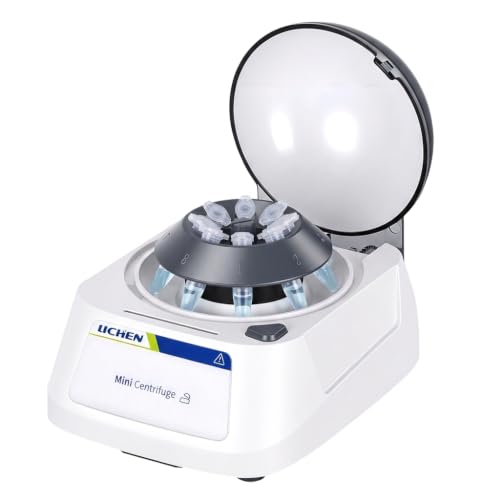
The LICHEN Microcentrifuge shares the same compact 8,000 RPM format as the Lichen Mini Centrifuge, including a tube rotor and a PCR-strip rotor. Closing the lid starts rotation, and opening it stops the run, so your workflow is based on direct physical control rather than a menu.
Its 2.2-pound body and wide 100-240V input suit compact spaces where you need quick microtube preparation. For most small-tube workflows, that uncomplicated approach is enough, provided fixed speed matches your protocol.
Points In Its Favor
- Two interchangeable rotors cover tube and strip formats.
- Closing the lid begins operation without parameter entry.
Areas To Watch
- It cannot accept the 7 mL, 10 mL, or 15 mL tubes handled by the ONiLAB models.
- Fixed-speed use requires you to confirm protocol compatibility beforehand.
- The small eight-position rotor may not suit larger batch work.
Made For
You get the most from this unit in a small prep area handling PCR strips and 0.2 mL to 2.0 mL tubes.
Consider Something Else When
LICHEN Benchtop Centrifuge 8x15ml 100-5000rpm fits you better when programmable runs and 15 mL tube work are routine.
LICHEN’s eight-place benchtop model offers the broadest programmed control in this group. It stores five settings, runs from 100 to 5,000 RPM, and reaches a stated 2,795 × g, edging above the 2,600 × g six-place models.
The aluminum-alloy rotor detaches for rinsing, a practical detail for a busy lab bench. At 330 × 280 × 240 mm and 6.5 kg, you’ll want to give it a settled home rather than treat it as portable equipment.
Where It Delivers
- Five saved programs support several recurring procedures.
- Eight 15 mL tube positions expand batch capacity.
- Speed starts at 100 RPM for lower-speed work.
- Aluminum-alloy rotor removes for rinsing after spills.
Honest Caveats
- Its 6.5 kg weight and stated dimensions require dedicated bench space.
- Adapters are needed for a snug fit with some tube types.
What Matters Before Selecting a PRP Centrifuge
Tube Format Comes First
Start with the tube sizes you actually use. The compact Lichen and LICHEN units accept microtubes and PCR strips only, while the ONiLAB and Maccx benchtop units support listed adapters up to 15 mL. Regular 50 mL work points directly toward the ONiLAB Benchtop Centrifuge 6X50ml.
Adjustable Control Versus Fixed Speed
Adjustable RPM, g-force, and timer settings help you follow a defined lab procedure with more precision. Fixed-speed microcentrifuges remove setup decisions and suit quick spin-down work. Your established workflow should determine which approach makes more sense.
Program Memory and Daily Routine
Stored programs matter most when you repeat the same settings through the day. The ONiLAB six-place models provide two saved settings, while the LICHEN Benchtop Centrifuge 8x15ml 100-5000rpm holds five. For occasional work, simple manual controls may be all you need.
Footprint and Bench Placement
Large-capacity machines need a stable counter location, particularly units with cast-iron bases or heavier housings. A mini centrifuge saves room but gives up larger tube compatibility and adjustable controls. Measure your available work surface before narrowing your shortlist.
Details That Shape the Decision
Common Shopping Slip Ups
Do not select by RPM alone. Confirm tube capacity, rotor format, timer range, and whether your procedure needs adjustable g-force before settling on a machine.
Where the Extra Money Goes
Higher-tier benchtop units often add programmable settings, finer control increments, larger rotors, detachable components, and more substantial base construction. Those additions matter most for frequent, repeatable multi-tube routines.
Final Thoughts
Your strongest match depends on the tubes already central to your workflow. The ONiLAB and Maccx models suit adjustable six-tube procedures, the Lichen compact models fit microtube tasks, and the LICHEN eight-place unit adds broader program storage. Match capacity and controls to your actual bench routine, and the choice becomes much clearer.