

Hand therapy tools help rebuild grip strength, control swelling, and track measurable progress.
Compact, graduated exercisers let users increase resistance step by step without risking overload. Top picks include color‑coded Vive squeeze balls, the FitBeast 9‑piece set, Handmaster Plus tentacles, the FitBeast Flex Therapy Bar, and Roygra multi‑packs.
Below are quick use cases, dosing tips, and guidance for choosing the right resistance and materials.
| Vive Hand Therapy Squeeze Balls for Grip Strength |

| Rehab Starter | Purpose / Use: Strengthen fingers/hands/wrists/forearms; rehab, arthritis, carpal tunnel, stress relief | Resistance Levels / Progression: Color-coded progressive resistances (orange extra soft → purple firm) | Portability: Compact 5 cm balls suitable for travel/use anywhere | VIEW LATEST PRICE | Read Our Analysis |
| FitBeast 9-Piece Grip & Forearm Strength Trainer |

| Most Versatile | Purpose / Use: Hand/finger/forearm strengthening and rehab; recovery from fractures, arthritis, tendonitis; performance training | Resistance Levels / Progression: Progressive kit: grip rings ~10–60 lb range + finger bands (6.6–11 lb) | Portability: Compact, lightweight kit; portable with manual/poster | VIEW LATEST PRICE | Read Our Analysis |
| Handmaster Plus Hand & Forearm Exerciser (9-Pack) |
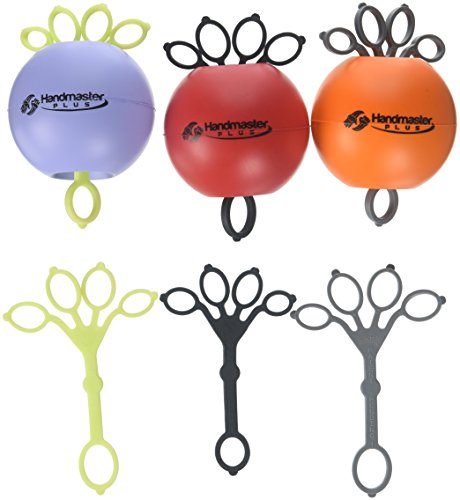
| All-Muscle Trainer | Purpose / Use: Improve grip/forearm strength, flexibility; rehab, injury prevention, performance enhancement | Resistance Levels / Progression: Three ball resistances (soft, medium, firm) via cords — progressive tension | Portability: Small, portable 9-piece set for anytime/anywhere use | VIEW LATEST PRICE | Read Our Analysis |
| FitBeast Flex Therapy Bar for Tennis & Golfers’ Elbow |

| Best for Elbow Rehab | Purpose / Use: Rehabilitation for tennis/golfer’s elbow; reduce pain, improve grip strength and flexibility | Resistance Levels / Progression: Four color-coded resistances (6, 10, 15, 25 lb) | Portability: Four compact therapy bars (portable package with manual) | VIEW LATEST PRICE | Read Our Analysis |
| Roygra Grip Strength Trainer 8-Pack for Hand Therapy |

| Best Beginner Kit | Purpose / Use: Hand/finger strength and therapy; physical therapy, sports, musicians, arthritis prevention/relief | Resistance Levels / Progression: Multiple resistance items across pack providing 2–3 resistance levels | Portability: Lightweight, portable 8‑pack with storage bag | VIEW LATEST PRICE | Read Our Analysis |
More Details on Our Top Picks
Vive Hand Therapy Squeeze Balls for Grip Strength
In case you’re rebuilding hand strength after injury or managing conditions like arthritis or carpal tunnel, the Vive Hand Therapy squeeze balls are a smart choice — their color-coded resistance (from extra soft to firm) lets you progress safely and measure gains during rehab. You can target fingers, hands, wrists and forearms, reduce stiffness, and enhance circulation for less joint pain. The set’s orange, green, blue and purple resistances support gradual training and interval work. At 5 cm diameter they fit adult hands; the odorless, latex-free, lightly textured balls resist tearing. A rehab video app and 60-day guarantee round out the package.
- Purpose / Use:Strengthen fingers/hands/wrists/forearms; rehab, arthritis, carpal tunnel, stress relief
- Resistance Levels / Progression:Color-coded progressive resistances (orange extra soft → purple firm)
- Portability:Compact 5 cm balls suitable for travel/use anywhere
- Target Populations / Conditions:Athletes, musicians, office staff, students, rehab patients, ADHD/autism sensory users
- Material / Durability:Premium composite; odorless, latex-free; tear- and split-resistant; nonslip texture
- Includes Instructional Support:Rehab video app included
- Additional Feature:Color-coded progressive set
- Additional Feature:Rehab video app
- Additional Feature:Odorless latex-free material
FitBeast 9-Piece Grip & Forearm Strength Trainer
Should you need targeted, progressive resistance for rehab or performance, the FitBeast 9-Piece Grip & Forearm Strength Trainer delivers adjustable grip rings and finger bands so you can build strength from basic recovery up to demanding conditioning. You get nine pieces: progressive grip rings (10–20 lb up to 50–60 lb) and six finger stretch bands (Soft 6.6 lb, Medium 8.8 lb, Hard 11 lb). Made from food-grade silicone, pieces are durable, non-slip, and ergonomic (thumb hole 0.8 in, finger holes 0.67 in). It’s compact, comes with guides, and suits rehab, office use, climbers, and athletes.
- Purpose / Use:Hand/finger/forearm strengthening and rehab; recovery from fractures, arthritis, tendonitis; performance training
- Resistance Levels / Progression:Progressive kit: grip rings ~10–60 lb range + finger bands (6.6–11 lb)
- Portability:Compact, lightweight kit; portable with manual/poster
- Target Populations / Conditions:Rehab patients, climbers, athletes, office workers, professionals
- Material / Durability:Food-grade silicone; high-stretch, break-resistant; non-slip texture
- Includes Instructional Support:Follow-along training poster, instructional manual, tutorial guide
- Additional Feature:Finger multi-hole design
- Additional Feature:Food-grade silicone
- Additional Feature:Compact travel kit
Handmaster Plus Hand & Forearm Exerciser (9-Pack)
Reach stronger, more flexible hands with the Handmaster Plus 9-piece set, a portable kit that gives you three resistance levels—soft (purple), medium (red), and firm (orange)—so you can progress safely from rehab to performance training. You get one flex ball per level plus two matching cords each, totaling nine pieces for varied grip and forearm work. Use it to improve grip strength, tone forearm muscles, increase flexibility, relieve pain and anxiety, and prevent or rehab conditions like tennis elbow, tendonitis, arthritis, RSI, and Dupuytren’s. Durable, skin-friendly materials and highly elastic tentacles support long-term, safe daily use anywhere.
- Purpose / Use:Improve grip/forearm strength, flexibility; rehab, injury prevention, performance enhancement
- Resistance Levels / Progression:Three ball resistances (soft, medium, firm) via cords — progressive tension
- Portability:Small, portable 9-piece set for anytime/anywhere use
- Target Populations / Conditions:Sportspeople, musicians, rehab patients, general users (e.g., golfers, writers)
- Material / Durability:High-quality, skin-friendly elastic material; durable tentacles
- Includes Instructional Support:Implied exercise guidance (portable set designed for rehab/use anywhere) — includes usage guidance
- Additional Feature:Targets all 18 hand muscles
- Additional Feature:Elastic tentacle cords
- Additional Feature:Soft skin-friendly texture
FitBeast Flex Therapy Bar for Tennis & Golfers’ Elbow
In the event you’re rehabbing tennis or golfer’s elbow and need targeted, progressive resistance, the FitBeast Flex Therapy Bar is built for you—its four color-coded tension levels (6–25 lb) let you safely increase load to reduce pain, restore wrist and forearm function, and rebuild grip strength. You’ll get a 4-piece set (yellow 6 lb, green 10 lb, blue 15 lb, red 25 lb) in ergonomic, non-slip thermoplastic elastomer bars that suit progressive PT and sports-specific training. The package includes an exercise manual and a 2-year warranty; dimensions and weight make it portable, and customers rate it 4.7/5.
- Purpose / Use:Rehabilitation for tennis/golfer’s elbow; reduce pain, improve grip strength and flexibility
- Resistance Levels / Progression:Four color-coded resistances (6, 10, 15, 25 lb)
- Portability:Four compact therapy bars (portable package with manual)
- Target Populations / Conditions:Athletes (tennis/golf), artists, musicians, patients with tennis/golfer’s elbow
- Material / Durability:Thermoplastic elastomers; ergonomic, non-slip
- Includes Instructional Support:Exercise manual with guided workouts and progression advice
- Additional Feature:Twist-bar design
- Additional Feature:Four color resistances
- Additional Feature:2-year manufacturer warranty
Roygra Grip Strength Trainer 8-Pack for Hand Therapy
Who benefits most from the Roygra Grip Strength Trainer 8-Pack? You do provided you need versatile, portable hand rehab or strength work. The set includes three exercise balls, two grip rings, three finger stretchers, a storage bag, manual, and gift box. Made from eco-friendly silicone, the pieces resist tearing, wash easily, and you can rinse sticky balls. Designed for all ages and sizes, the pack offers 2–3 resistance levels so you can progress from beginner to advanced. Use it for physical therapy, sports like climbing or tennis, musicians, or office workers seeking grip balance and arthritis relief.
- Purpose / Use:Hand/finger strength and therapy; physical therapy, sports, musicians, arthritis prevention/relief
- Resistance Levels / Progression:Multiple resistance items across pack providing 2–3 resistance levels
- Portability:Lightweight, portable 8‑pack with storage bag
- Target Populations / Conditions:Men, women, seniors, teens, children; athletes and musicians; rehab users
- Material / Durability:Eco-friendly silicone; durable, washable, tear-resistant
- Includes Instructional Support:Instruction manual included (and gift box/storage bag)
- Additional Feature:Includes storage bag
- Additional Feature:Gift-ready packaging
- Additional Feature:Washable eco-silicone
Factors to Consider When Choosing Physical Therapy Hand Exercisers
At the moment of choosing a hand exerciser, you’ll want to check resistance level variety so you can progress safely and avoid plateaus. Make certain the size, fit, material safety and durability match your hand, skin sensitivities, and daily use. Also consider ergonomics and grip, plus portability and accessories, to guarantee the device fits your lifestyle and therapy goals.
Resistance Level Variety
Because strength needs change from acute rehab to long-term conditioning, choose hand exercisers that offer multiple, graduated resistance levels so you can progress safely without swapping devices. Pick devices with ranges spanning very light to heavy and with small, measurable increments (about 2–5 lb or clearly labeled soft/medium/firm) so you can apply gradual overload and track gains. Include tools that provide both compressive (squeeze) and finger‑extension resistance to balance flexor and extensor training. Match your starting resistance to injury stage—very light after surgery, moderate in subacute rehab, heavier for long‑term strengthening. Finally, verify the design and materials keep resistance consistent over repetitions and time so prescribed dosing stays accurate and progression remains reliable.
Size And Fit
Once you’ve matched resistance to rehab stage, check size and fit so exercises feel natural and safe. Choose devices with diameters or hole sizes that match your hand span so you can close fully without overextension; for most adults, grip tools around 5–6 cm suit typical palms. Make certain finger exercisers and multi-hole bands have spaced openings (about 15–23 mm) so fingers and thumb sit naturally without crowding or slipping. In case you have smaller hands, arthritis, or swelling, pick smaller, softer implements or ones that accommodate altered joint angles to avoid pain and poor mechanics. Pay attention to thickness and surface texture—contoured, lightly textured shapes aid secure grip. Prefer kits with adjustable sizes or interchangeable inserts to adapt as your hand size changes.
Material Safety Durability
Although materials may seem secondary to resistance levels, they determine safety, comfort, and how long a hand exerciser will last. Choose hypoallergenic, latex-free options like medical-grade silicone or thermoplastic elastomers to cut skin irritation and allergy risk, especially with repeated use. Prefer odorless, food- or medical-grade, non-toxic materials free of phthalates and harmful plasticizers in case seniors or children will use the device. Check for tear- and split-resistant construction with high tensile strength and good elastic recovery so resistance and shape hold up after thousands of reps. Opt for textured, non-slip exteriors that maintain grip whenever hands get sweaty. Finally, verify that the device is washable or disinfectable and resists moisture, oils, and UV degradation to preserve hygiene and durability.
Ergonomics And Grip
Material choices affect comfort and longevity, but how a device fits your hand and how you hold it determines whether exercises stay effective and pain-free. Choose sizes and shapes that match your hand—about 4–6 cm diameters for average adult palms—so you get full contact and even force distribution whenever squeezing. Prefer textured, nonslip surfaces and finger-contour grips to stop slipping and cut compensatory wrist or forearm strain during reps. Make sure the tool lets your wrist stay neutral, avoiding excessive ulnar/radial deviation or flexion, which reduces joint stress and better targets intrinsic hand muscles. Opt for adjustable or color‑coded resistance that preserves ergonomic handle geometry across levels. Pick soft yet resilient materials that conform to fingertip pads and spread pressure to prevent shear and soreness.
Portability And Accessories
Anytime you’re balancing therapy with a busy life, portability becomes as vital as resistance levels—pick compact, lightweight exercisers (think pocket-sized or under about 6 inches and kits under ~0.5 kg) so you can keep them in a bag or desk drawer and actually use them regularly. Choose low-bulk designs that won’t add carrying fatigue between work, travel, and clinic. Prefer kits that include travel accessories—zippered pouches, small cases, or mesh bags—to protect pieces and prevent loss. Check for washable, tear-resistant, non-porous surfaces so items stay hygienic after frequent handling. Also look for bundled instructional materials or app/video access for quick guidance away from your therapist. These practical features make it far more likely you’ll stick with your program and progress steadily.
Rehab Specificity
Rehab specificity matters because different injuries and recovery stages demand exercises that target the exact structures and movement patterns you’re rebuilding. Choose tools that match the injured structure and motion — finger-extension devices for extensor tendons, grip/squeeze tools for flexors or intrinsic muscles. Match resistance increments to your stage: start very low (often under 5–10 lb) and progress in small, measurable steps toward functional goals. Prefer devices that allow isolated versus composite movements so you can isolate a tendon, nerve, or joint whenever needed, then move to coordinated grips. Guarantee adjustable dosage (reps, sets, holds, tempo) and reproducible resistance so therapists can prescribe progressive overload and track gains. Pick equipment that works in pain-limited ranges, partial arcs, or isometrics.