Dumbbells offer a convenient and effective way to strengthen your arms. You can easily use them at home or in the gym. This blog focuses on five killer moves designed to help you build strong, sculpted arms. Strong muscles in your upper limbs offer many benefits.
They improve your appearance and boost your functional strength for daily activities. You will carry groceries or lift children with less effort. This type of dumbbell arm workout also contributes to overall upper body strength, making everyday tasks more manageable. You will build muscle and prevent injuries.
Key Takeaways
Dumbbells help you build strong arms at home or the gym. They make daily tasks easier and prevent injuries.
Dumbbell exercises work each arm separately. This builds balanced strength and makes your core stronger.
Five key exercises build arm muscles: Bicep Curls, Hammer Curls, Overhead Triceps Extensions, Triceps Kickbacks, and Dumbbell Rows.
Always use the correct form for each exercise. This helps you get good results and avoids injuries.
Eat well, get enough sleep, and train regularly. These steps are important for growing strong arm muscles.
Why Dumbbell Arms Workout for Gains
Versatility and Accessibility
Dumbbells offer unique advantages for your arm training. They provide greater versatility compared to barbells or machines. Dumbbells consistently produce balanced and aesthetic arm gains. You will experience fewer joint aches and improved symmetry.
The freedom of movement with a dumbbell reduces strain. It actively engages stabilizer muscles, especially during unilateral exercises. Dumbbells deliver measurable progress in both size and strength during your training phases. This includes strength training and hypertrophy. A dumbbell arms workout promotes balanced muscle development.
Each side of your body works independently. This helps correct muscle imbalances. It also enhances overall coordination and joint stability. Dumbbells offer a wider range of motion than machines. This leads to deeper muscle engagement and improved hypertrophy. This dumbbell arm workout approach is highly effective for building strong, functional arms.
Unilateral Training Benefits
Unilateral training means working one side of your body at a time. This approach offers significant benefits. It helps correct muscle imbalances. These imbalances often occur with bilateral exercises. For example, one arm might compensate for the other during barbell curls. Single Arm Dumbbell Bicep Curls directly address these issues.
They ensure each arm works independently. This builds balanced strength. Similarly, Single Arm Tricep Extensions are very effective. Overhead single-arm tricep extensions isolate all three heads of the triceps muscle. This combats imbalances.
It prevents one side from dominating, unlike some cable machine pulldowns. This type of training makes your upper limbs stronger and more symmetrical. You develop equal power on both sides.
Core Engagement and Stability
Dumbbell exercises do more than just build your arms. They also engage your core muscles. Unilateral exercises, like the Single Arm Kneeling Pull Back Row, actively engage your abs and core.
This happens because your body works to stabilize itself. You must maintain balance when lifting a weight with one hand. This constant stabilization effort strengthens your core. It improves your overall body control. Pull-ups also target your core muscles. Incorporating these movements into your routine improves overall body stability. It makes your entire body stronger and more resilient.
The 5 Best Arm Workouts with Dumbbells
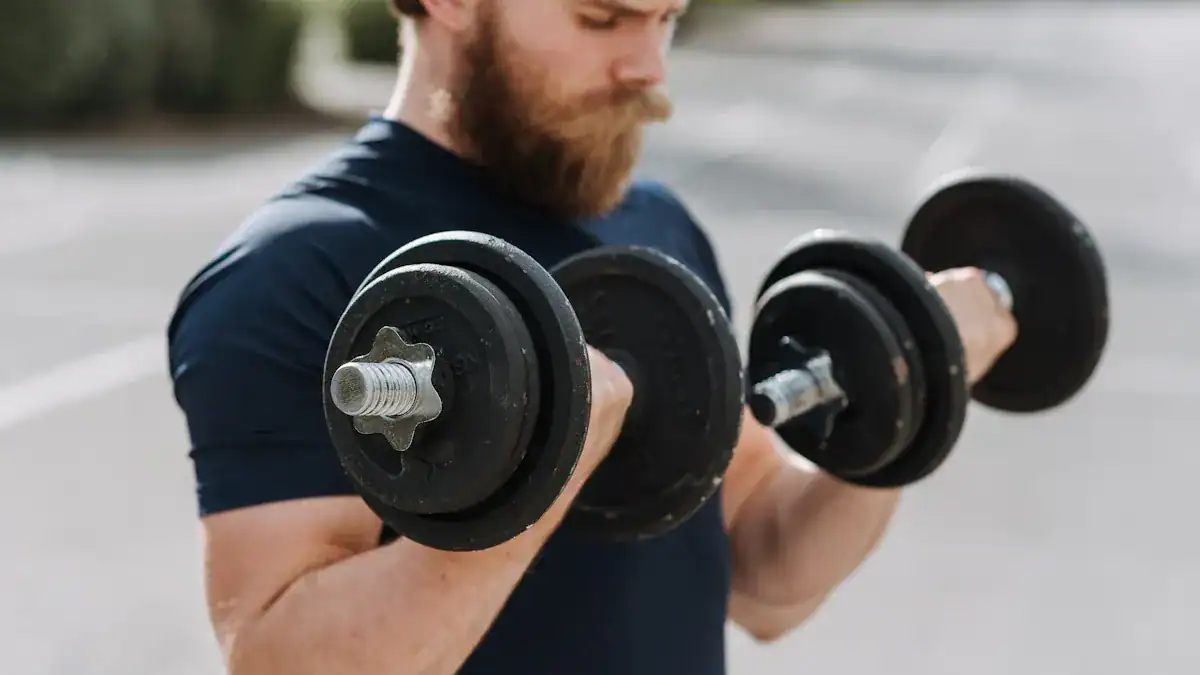
You want strong, defined arms. These five exercises are the best arm workouts to help you achieve that goal. Each move targets specific muscles. They build both size and strength. Incorporate them into your routine for a complete arm workout.
Bicep Curls
Bicep curls are a classic exercise. They build the front of your upper arms. This move is essential for developing your biceps. To begin, hold a dumbbell in each hand. Your arms should extend downwards at your sides. Keep your elbows close to your torso. Relax your shoulders. This starting position ensures proper form.
Hammer Curls
Hammer curls are another one of the best arm workouts. They target multiple muscles in your upper arm and forearm. These include the brachialis, brachioradialis, and biceps brachii. The brachialis sits beneath your biceps. It helps with elbow flexion. The brachioradialis is a forearm muscle. It assists with elbow flexion and grip strength. The biceps brachii is the main muscle at the front of your upper arm. It flexes your elbow and rotates your forearm.
Overhead Triceps Extension
This exercise is one of the best arm workouts for your triceps. It works all three heads of the triceps muscle. This helps create a balanced and strong upper arm. When performing this move, extend your forearms overhead. Your arms should be fully extended. Avoid locking out your elbows at the top.
Triceps Kickbacks
Triceps kickbacks are a killer arm workout. They isolate your triceps effectively. You must use proper form to get the most from this exercise. Avoid common errors. Do not move your elbows back and forth. Keep them steady and anchored to your sides. Do not shorten your range of motion. Fully extend your elbows on each repetition. Avoid swinging the weight. Perform reps slowly and with control. Also, do not break at the wrist. Keep your wrist neutral. Do not rock at the elbow.
Dumbbell Rows for Arm Strength
Dumbbell rows are not just for your back. They also contribute significantly to arm strength. This technique develops your frontal arm muscles. These include your forearms and biceps. Forearms are responsible for grip strength. Biceps assist in elbow flexion.
Dumbbell rows offer a significant advantage for developing bigger arms. Unilateral training with dumbbell rows targets each bicep and forearm individually. This corrects muscular imbalances. It strengthens individual arm muscles. This workout engages your biceps, which are crucial for arm strength development.
Mastering Each Move for Results
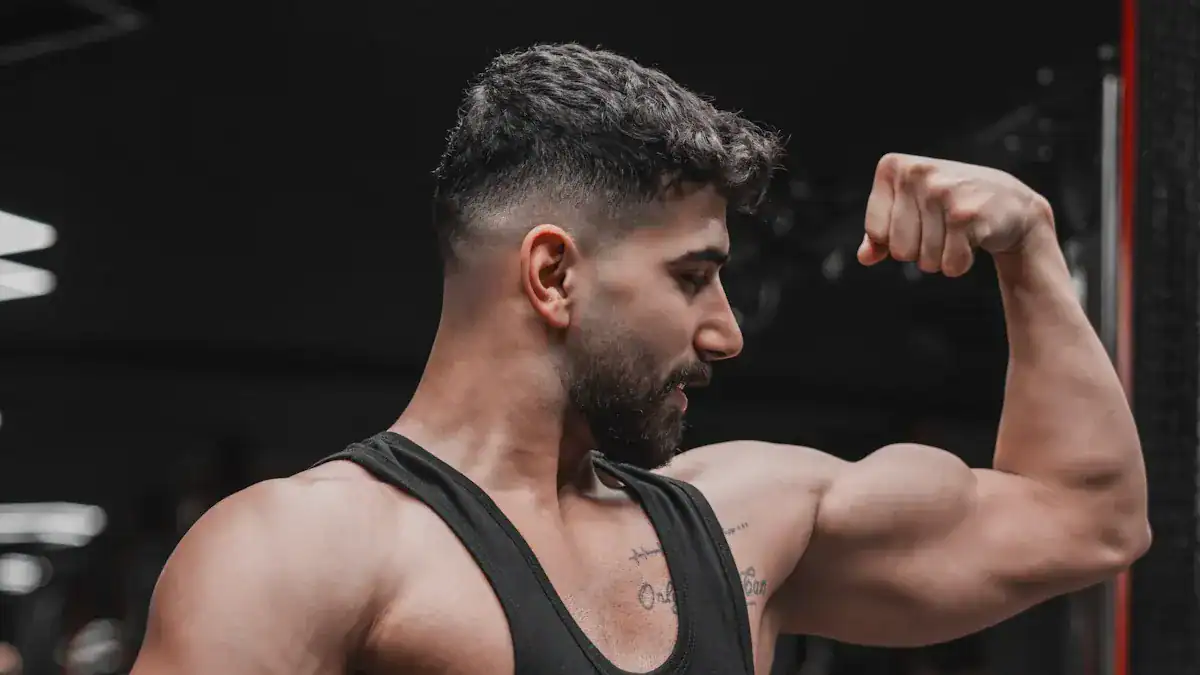
You will achieve the best results by understanding each exercise. Proper form is key. It ensures you work the right muscles. It also prevents injuries. Here is how to master each move.
Proper Form and Execution
Bicep Curls
Bicep curls are excellent for building your biceps. You perform them with precision.
How to Perform:
Stand straight. Hold a dumbbell in each hand. Your feet should be shoulder-width apart. Your arms hang at your sides.
Keep your knees and elbow joints relaxed. Engage your core muscles.
Ensure your palms face forward.
Engage your biceps to lift the dumbbells. Keep your elbows close to your body. Your upper arms must stay still. Only your forearms should move.
Exhale as you lift the dumbbells.
Maintain a straight back. Pull your shoulders back. Keep your head up.
Lift the dumbbells to shoulder level.
Slowly lower your arms back to the start. Control the movement.
Repeat the movement.
Muscles Targeted: This exercise primarily targets your biceps brachii. It also works your brachialis and brachioradialis.
Common Mistakes:
Swinging the weight: You use momentum instead of muscle. This reduces effectiveness.
Elbows flaring out: Keep your elbows tucked in. This isolates the biceps.
Not controlling the descent: Lower the weight slowly. This builds more muscle.
Recommended Sets and Reps: For muscle growth, aim for 3-5 sets. Do 8-15 repetitions per set. You can also do 2 sets of 10 repetitions. Then do 2-3 more sets to failure. Use a challenging weight.
Hammer Curls
Hammer curls build your arms differently. They target more muscles.
How to Perform:
Stand with straight but not stiff legs. Your knees align under your hips.
Hold a dumbbell in each hand at your sides. Your palms face your thighs. Your thumbs point forward. Your shoulders are relaxed.
Bend at the elbow. Lift the weights towards your shoulders. Keep your upper arms stationary. Your wrists align with your forearms.
Pause for one second at the peak. Your thumbs are near your shoulders. Your palms face inward.
Slowly lower the weights back to the start.
Engage your abdominal muscles throughout. This prevents lower back movement.
Muscles Targeted: This exercise works several muscles.
Biceps Brachii: This is the most visible elbow flexor. It flexes your elbow. It also helps with shoulder flexion.
Brachioradialis: This muscle aids in elbow flexion. It adds mass to your forearm.
Brachialis: This is the strongest elbow flexor. It sits under your biceps.
Common Mistakes:
Using too much momentum: Control the lift. Do not swing the weights.
Not keeping upper arms still: Only your forearms should move.
Rushing the movement: Slow, controlled reps are more effective.
Recommended Sets and Reps: Perform 3-5 sets. Aim for 8-12 repetitions per set.
Overhead Triceps Extension
This move targets your triceps. It helps build the back of your upper arms.
How to Perform:
Sit or stand tall. Hold one dumbbell with both hands. Your palms face up.
Lift the dumbbell overhead. Your arms are fully extended. Do not lock your elbows.
Slowly lower the dumbbell behind your head. Bend your elbows. Keep your elbows pointing forward.
Extend your arms to lift the dumbbell back to the starting position. Squeeze your triceps at the top.
Control the movement. Do not let the weight drop.
Muscles Targeted: This exercise works all three heads of your triceps brachii.
Long Head: This head gets maximum stimulation.
Lateral Head: This head adds to arm width.
Medial Head: This head assists in full elbow extension.
Secondary muscles include your anconeus, posterior deltoids, and abdominals. Your core muscles engage to stabilize your torso.
Common Mistakes:
Flaring elbows: Keep your elbows close to your head.
Using too much weight: This leads to poor form. You might arch your back.
Not fully extending: Extend your arms completely. This fully engages your triceps.
Recommended Sets and Reps: Aim for 5 sets of 10 repetitions. Do this workout twice a week for 12 weeks.
Triceps Kickbacks
Triceps kickbacks isolate your triceps. They are great for shaping the back of your arms.
How to Perform:
Grab a set of dumbbells.
Bring your torso forward. Bend your knees slightly.
Hinge forward at your waist. Your torso is almost parallel to the floor.
Keep your back straight. Engage your core. Your head aligns with your spine.
Bring your elbows up. Your upper arms are parallel to the floor. Keep them close to your body.
Exhale. Kick back until your arms are fully extended. Only your forearms move.
Pause. Squeeze your triceps.
Slowly lower the weights to the start. Inhale.
Repeat.
Muscles Targeted: The triceps brachii is the primary muscle. The lateral head of the triceps is mainly activated. Your deltoid muscles also work.
Common Mistakes:
Using the wrong resistance: Choose a weight that allows full range of motion. Do not use momentum.
Letting elbows flare: Keep your arms against your sides.
Bending wrists: Maintain straight wrists. This maximizes triceps recruitment.
Rounding your back: Keep your back neutral. Keep your core tight.
Recommended Sets and Reps: Perform 2-3 sets. Do 10-15 repetitions per set.
Dumbbell Rows for Arm Strength
Dumbbell rows build your back. They also significantly boost your arm strength. This strength training exercise develops your forearms and biceps.
How to Perform:
Place one knee and one hand on a bench. Your back is flat. Your core is engaged.
Hold a dumbbell in your free hand. Let it hang towards the floor.
Pull the dumbbell up towards your chest. Keep your elbow close to your body.
Focus on pulling with your back muscles. Imagine pulling your elbow towards your hip.
Pause at the top. Squeeze your shoulder blade.
Slowly lower the dumbbell back down. Control the movement.
Allow for a big stretch at the bottom. Do not lose spinal position.
Repeat for one side. Then switch sides.
Muscles Targeted: This exercise primarily targets your lats. It also works your biceps, forearms, and rear deltoids. Your core muscles stabilize your body.
Common Mistakes:
Relying on biceps: Do not over-pull with your biceps. Maintain a 90-degree angle between your upper arm and forearm.
No control on lifts: Control the lowering phase. Take 3-4 seconds to lower the weight.
No pause at peak contraction: Pause at the top. Feel your lats contract.
No stretch at the bottom: Allow a full stretch. This is more effective for muscle growth.
Going too heavy: Prioritize proper form. Control the weight. Avoid excessive movement.
Recommended Sets and Reps: Aim for 3-4 sets. Do 8-12 repetitions per side. Adjust for your training goals.
Targeted Muscle Activation
You activate specific muscles with each move. Bicep curls focus on the front of your upper arms. Hammer curls work your forearms and deeper arm muscles. Overhead triceps extensions hit all three heads of your triceps. Triceps kickbacks isolate the lateral head of your triceps. Dumbbell rows engage your back, biceps, and forearms. Understanding this helps you feel the muscle working.
Avoiding Common Errors
You must avoid common errors. They reduce effectiveness. They can also cause injury. Always prioritize form over weight. Watch yourself in a mirror. This helps you check your technique. If you feel pain, stop. Adjust your form or lower the weight.
Sets and Reps Guidance
Your sets and reps depend on your goal.
For muscle growth (hypertrophy): Aim for 3-5 sets of 8-15 repetitions. Use a weight that challenges you.
For strength: Use heavier weights. Do fewer repetitions, like 4-6 reps.
For endurance: Use lighter weights. Do more repetitions, like 15-20+ reps. Always listen to your body. Rest when you need to.
Your Killer Dumbbell Arm Workout Routine
You now know the best moves. It is time to put them into a complete plan. This section guides you. You will combine the five exercises into a powerful workout program. This plan helps you build stronger arms.
Sample Workout Structure
You need a good plan for your workout. Start with a warm-up. This prepares your muscles. It also prevents injury.
Warm-up (5-10 minutes):
Begin with light cardio. Do jumping jacks or brisk walking. Do this for 5-10 minutes.
Perform dynamic stretches for your upper body. Include arm circles and shoulder rolls. Do cross-arm stretches.
Stretch your arms and shoulders dynamically. This prevents injury. It also helps your progress.
The Workout (20-30 minutes):
Perform the exercises in this order. This ensures balanced muscle work.
Dumbbell Rows for Arm Strength: 3 sets of 8-12 reps per side.
Overhead Triceps Extension: 5 sets of 10 reps.
Bicep Curls: 3-5 sets of 8-15 reps.
Triceps Kickbacks: 2-3 sets of 10-15 reps.
Hammer Curls: 3-5 sets of 8-12 reps.
Rest for 60-90 seconds between sets. This allows for recovery.
Cool-down (5 minutes):
Finish with static stretches. Hold each stretch for 20-30 seconds.
Stretch your biceps. Stretch your triceps. Stretch your shoulders. This improves flexibility. It also aids recovery.
Progressive Overload Strategies
You must challenge your muscles. This helps them grow. Progressive overload is key to your training. It makes your muscles adapt. Here are ways to make your workout harder:
Increase weight: Start with a weight you can lift correctly. Aim to increase the dumbbell weight by 2-5% each week.
Increase repetitions: You cannot lift heavier weights yet. Make your workout harder. Increase the number of reps you do.
Increase sets: You want to increase repetitions over time. Start by adding more working sets.
Decrease rest time: This increases workout intensity. You do not need to add more weight or reps.
Increase range of motion: This engages more muscle fibers. It builds strength. It also improves your mobility.
Consider advanced variations. Incline curls are a good example. They challenge your biceps differently. This plan helps you get stronger.
Optimal Training Frequency
How often should you train your arms? This depends on your goals. It also depends on your recovery.
Train your triceps 2-3 times per week.
You can train your biceps 3-4 times per week. Biceps exercises often have a smaller range of motion. This allows for more frequent training.
You can achieve similar muscle gains. Do one or more weekly training sessions per muscle group. The total number of sets must be the same. Total weekly volume drives muscle strength and growth. It is not just how often you train. Higher training frequency helps you get enough training volume. It also helps with quality sets. This is true for heavy training. It aims for maximum strength gains. It does not cause too much fatigue. This workout plan helps you reach your goals.
Maximizing Arm Gains Beyond the Workout
Building strong arms involves more than just your workout. What you do outside the gym greatly impacts your results. You need to focus on nutrition, rest, and consistency. These factors support your training plan and help you build muscle effectively.
Nutrition for Muscle Growth
Your diet fuels muscle growth. You must provide your body with the right nutrients. Protein is essential for muscle building. Aim for 1.4 to 2.0 grams of protein per kilogram of body weight daily.
Good sources include salmon, chicken, quinoa, and tofu. Carbohydrates are also vital. They replenish energy stores and prevent fatigue during your workout. About 45% to 55% of your daily calories should come from carbs. Choose whole grains, sweet potatoes, and fruits.
Fats are important too. They should make up 20% to 30% of your daily calories. Include healthy fats from avocados, nuts, and olive oil. To build muscle, you need enough calories. Eat a meal with protein and carbs every 2-3 hours. This provides a steady supply of energy for your arms.
Importance of Rest and Recovery
Your muscles grow when you rest, not just when you train. Sleep is a critical part of your recovery plan. Adults aiming to increase muscle mass need 7-9 hours of sleep nightly. This duration is crucial before and after your workout. It helps maximize the benefits of your physical effort.
Getting only six hours of sleep regularly is often not enough for effective muscle building. While a small reduction in sleep (1-2 hours) might not always affect strength gains, prioritizing adequate rest is key for overall progress.
Consistency is Key
You must stick to your plan. Consistency is the most important factor for long-term success. You will not see results overnight. Regular training and proper nutrition over time lead to significant gains. Follow your workout schedule. Make healthy eating a habit. Give your body the rest it needs. This consistent effort will help you build strong, sculpted arms. Your dedication to the entire plan will pay off.
This dumbbell arm workout offers a simple, effective way to build strong, defined arms. You can easily incorporate these five killer dumbbell moves into your routine. Remember, proper form, consistent effort, and adequate recovery are crucial for achieving desired results. Start your dumbbell arm workout journey today. You will experience a great transformation. This plan helps you build muscle.