The Wechsler Adult Intelligence Scale (WAIS) is a widely recognized tool for intelligence testing in adults. Many consider this Wechsler instrument the gold standard for cognitive assessment. This blog post aims to demystify WAIS IQ scores and provide a clear understanding of what these results represent. Understanding the WAIS test results holds significant importance.
It offers valuable personal insight and supports various professional contexts. The Wechsler provides comprehensive scores from this standardized test.
Key Takeaways
The WAIS test measures adult intelligence. It looks at different mental abilities, not just one.
The WAIS gives a Full Scale IQ score. It also provides four main index scores. These scores show specific strengths and weaknesses.
WAIS scores help in many areas. They are useful for diagnosis, school planning, and job choices.
WAIS results are a snapshot in time. Many things can affect them. These include culture, language, and stress.
Only trained experts should give and explain WAIS tests. This ensures the results are correct and fair.
The WAIS Test: What It Is

Overview of the WAIS
The WAIS is an intelligence test designed for adults and older adolescents. The current version is the WAIS-IV. This wais test measures intelligence using different mental abilities. It does not just provide one general score. The wechsler instrument offers a comprehensive evaluation.
It assesses verbal comprehension, perceptual reasoning, working memory, and processing speed. The WAIS-IV test is designed for individuals aged 16 years 0 months to 90 years 11 months. This makes it a broad tool for intelligence testing for adults. The wais test helps understand an individual’s cognitive profile. It provides a detailed picture of how a person thinks and solves problems.
Structure and Components
The wais test provides a Full Scale IQ (FSIQ). This FSIQ comes from several subtests. These subtests group into four primary index scores. They are the Verbal Comprehension Index (VCI), Perceptual Reasoning Index (PRI), Working Memory Index (WMI), and Processing Speed Index (PSI). The VCI assesses verbal reasoning, comprehension, and concept formation. Its subtests include Similarities, Vocabulary, and Information.
The PRI evaluates non-verbal reasoning and problem-solving skills. The WMI measures short-term memory and the ability to mentally manipulate information. The PSI assesses how quickly one processes visual information and makes decisions. The wechsler provides a detailed profile of cognitive strengths and weaknesses through these indices.
Index | Core Subtests |
|---|---|
Verbal Comprehension (VCI) | Similarities, Vocabulary, Information |
Perceptual Reasoning (PRI) | Block Design, Matrix Reasoning, Visual Puzzles |
Working Memory (WMI) | Digit Span, Arithmetic |
Processing Speed (PSI) | Symbol Search, Coding |
The Administration Process
A trained professional administers the wais test. This ensures standardized conditions. The administrator presents tasks verbally or visually. The individual responds verbally, by pointing, or by manipulating objects.
The professional records all responses. The wais test typically takes between 60 and 90 minutes to complete. The exact duration can vary. It depends on the individual’s pace and the specific subtests given. After administration, the professional compiles the results.
They then interpret these results to generate the wais iq and other index scores. This comprehensive process ensures accurate and reliable data from the wechsler assessment. The wechsler provides valuable insights into cognitive functioning through these detailed results.
Understanding WAIS IQ Scores

Full Scale IQ (FSIQ) Explained
The Full Scale IQ (FSIQ) represents a person’s overall cognitive ability. It is a composite score. The full scale IQ combines results from various subtests within the wais test. This score gives a broad picture of intellectual functioning. While the FSIQ provides a single number, it does not mean intelligence is just one thing. It reflects a person’s general intellectual capacity.
The full-scale IQ shows a moderate relationship with other measures of general cognitive ability. For example, it correlates with adaptive behaviors. Adaptive behaviors are skills people use in daily life. These include conceptual, social, and practical skills.
Measure of General Cognitive Ability (Adaptive Behavior) | Correlation Coefficient (r) |
|---|---|
Conceptual Skills | 0.64 |
Practical Skills | 0.39 |
DABS Total Score | 0.46 |
Adaptive Behavior Composite (Meta-analysis mean) | 0.51 |
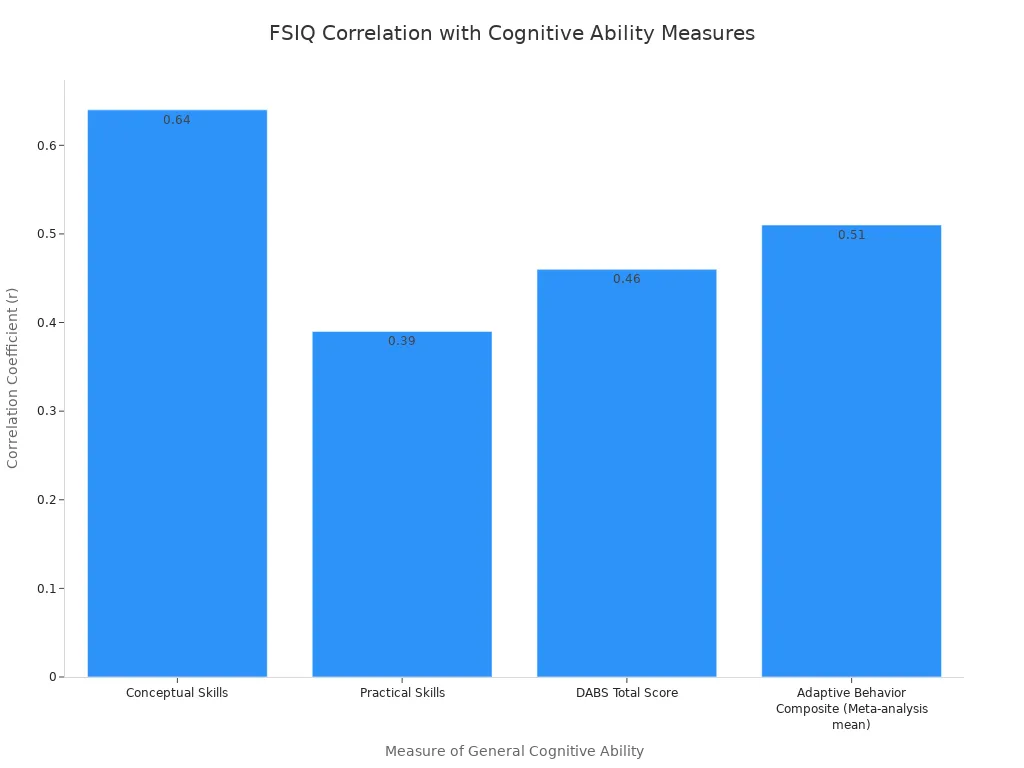
FSIQ and adaptive behavior are separate ideas. They are independent but related. The conceptual domain of adaptive behavior shows the highest correlation with FSIQ. This suggests different areas of adaptive behavior relate differently to FSIQ. The wechsler FSIQ does not measure only “g,” or general intelligence. “g” is a scientific idea. IQ is a mix of “g,” specific mental abilities, and specific mental skills. This means IQ is not just “g.” The wais iq results offer a comprehensive view.
The Four Primary Index Scores
The wais test provides four primary index scores. These scores offer a more detailed look at specific cognitive strengths and weaknesses. They are the Verbal Comprehension Index (VCI), Perceptual Reasoning Index (PRI), Working Memory Index (WMI), and Processing Speed Index (PSI).
Verbal Comprehension Index (VCI): This index measures a person’s ability to understand and use verbal information. It assesses abstract verbal reasoning, vocabulary, and general knowledge. A person’s VCI score shows how well they listen to questions. It also shows how they use learned information. They reason through an answer and express thoughts aloud. This index can also show if someone prefers verbal information.
Perceptual Reasoning Index (PRI): This index evaluates non-verbal reasoning and problem-solving skills. It looks at visual-spatial processing and inductive reasoning. The PRI score shows how a person examines a problem. They use visual-motor and visual-spatial skills. They organize thoughts, create solutions, and test them. This index can also reveal a preference for visual information. It shows comfort with new situations.
Index | Proposed abilities measured |
|---|---|
Verbal Comprehension | Abstract verbal reasoning; semantic knowledge; verbal comprehension and expression; general information acquired from culture; ability to express abstract social conventions, rules and expressions |
Perceptual Reasoning | Visual spatial processing and problem solving; visual motor construction; nonverbal abstract problem solving; inductive reasoning; visual spatial reasoning; ability to quickly perceive visual details; quantitative reasoning |
Working Memory Index (WMI): This index measures a person’s ability to hold and manipulate information in their mind for a short time. It reflects attention and concentration.
Processing Speed Index (PSI): This index assesses how quickly and accurately a person can process visual information. It measures how fast they make decisions.
These index scores provide a rich profile. They help understand a person’s cognitive strengths and areas for growth.
Interpreting Score Ranges
WAIS IQ results are typically presented on a scale with a mean of 100. A standard deviation of 15 applies. This means most people score near 100. The wechsler provides qualitative descriptions for different score ranges. These descriptions help interpret what a specific score means.
Score Range | Classification |
|---|---|
130 and above | Very Superior |
120-129 | Superior |
110-119 | High Average |
90-109 | Average |
80-89 | Low Average |
70-79 | Borderline |
69 and below | Extremely Low |
These classifications help place an individual’s results in context. For example, a score of 125 falls into the “Superior” range. This indicates a higher cognitive ability compared to the general population.
Norms and Deviation IQ
The wais test uses deviation IQ scores. This system compares an individual’s performance to others in their age group. The mean score is 100. The standard deviation is 15. This means that about 68% of people score between 85 and 115. Approximately 50% of people score between 90 and 110. This range is considered “Average.”
Most IQ tests are standardized with a mean score of 100 and a standard deviation of 15. Half of the population has IQs between 90 and 110.
The results from a wais test represent a snapshot in time. A person’s cognitive abilities can change over time. Factors like education, experience, and health can influence these abilities. Therefore, a single score does not define a person’s entire intellectual potential. It provides valuable information about their cognitive functioning at that specific moment.
Uses and Importance of WAIS Scores
Clinical and Diagnostic Applications
The Wechsler Adult Intelligence Scale (WAIS) serves as a crucial tool in clinical settings. Clinicians use the wais test for diagnostic purposes. It helps assess cognitive functioning in individuals with psychiatric conditions or brain injuries. The WAIS also helps evaluate patterns of brain dysfunction. For example, a person might score high in some areas and low in others on the WAIS.
This pattern can indicate a specific learning disability. Research shows that the Full Scale IQ (FSIQ) and General Ability Index (GAI) from similar Wechsler scales help classify intellectual disability. FSIQ is often recommended for diagnostic decisions when different reasoning abilities are similarly developed.
Studies also find a significant difference between FSIQ and GAI scores in people with neurocognitive disorders like learning disabilities and ADHD. In these cases, GAI scores are often higher than FSIQ.
The WAIS-IV is also a widely used neuropsychological test for assessing cognitive decline in older adults. This includes individuals with mild cognitive impairment (MCI) and dementia.
It helps identify problems in specific cognitive areas. These areas include perceptual reasoning, working memory, and processing speed. Detecting cognitive decline in high-functioning older adults can be difficult. Significant neurological changes may be needed before WAIS results meet standard criteria for impairment. For these individuals, the absence of high scores, rather than the presence of low scores, might signal cognitive decline. This could point to an underlying disease process.
Educational and Career Planning
WAIS scores offer valuable insights for educational and career planning. They help individuals understand their cognitive strengths. This understanding can guide choices about academic paths or professional fields.
A study from 1952 found that the WAIS Verbal composite correlated with university grades. Another study in 1965 showed that the WAIS Verbal composite correlated strongly with high school grades.
This suggests that verbal abilities, as measured by the wechsler, can predict academic success. The wais iq can help students choose subjects where they are likely to excel. It can also help adults identify careers that match their cognitive profile.
Research and Cognitive Insights
Researchers frequently use WAIS data to advance the understanding of cognitive development and aging. A cross-sectional study used the WAIS-5 to investigate cognitive aging. This study provided new insights using a five-factor approach.
It confirmed earlier research on cognitive aging patterns. Verbal skills remained stable until late middle age but declined significantly between ages 75 and 90. Similar declines appeared for working memory, fluid reasoning, visual spatial ability, and processing speed. The study used a diverse sample of adults aged 20–90 years. This comprehensive cognitive assessment helps researchers map how mental abilities change over a lifespan.
Limitations of WAIS Testing
Snapshot in Time” Nature
WAIS results represent a specific moment. They capture an individual’s cognitive abilities at the time of testing. These abilities can change over time. Factors like education, experience, and health influence cognitive function. Therefore, a single WAIS assessment does not define a person’s entire intellectual potential. It offers valuable information about their cognitive functioning at that specific moment.
Potential Biases and Factors
The WAIS may not fully account for cultural, linguistic, or socioeconomic differences. This can lead to biased results for individuals from diverse backgrounds. Linguistic biases in wais test administration, especially for English learners with limited English proficiency, can misrepresent true cognitive abilities.
Research shows that language abilities significantly influence cognitive test performance. Assessing these language abilities before administering and interpreting WAIS scores is crucial. This avoids under- or over-estimation of abilities. It ensures fair and valid test interpretation.
Non-cognitive factors also impact performance. Anxiety and stress can significantly influence WAIS performance. Studies show that self-reported anxiety negatively affects performance across various cognitive tasks. Test anxiety, characterized by fear of failure, interferes with performance.
Situational test-related anxiety links to poorer performance on neuropsychological tests. This includes areas like learning, memory, and processing speed. Other non-cognitive factors like acculturation, education, and income also contribute to variance in test results.
Need for Comprehensive Evaluation
The wais test provides valuable data. However, it is only one piece of a larger puzzle. A comprehensive evaluation often includes other assessment tools. These tools provide a more complete picture of an individual’s cognitive profile. Other assessments include:
Behavioral assessments
Emotional assessments
Functional assessments
Clinical observations
Stanford-Binet Intelligence Scales
Professionals combine WAIS data with these other assessments. This approach ensures a thorough understanding of an individual’s strengths and challenges.
Ethical Considerations
Administering the wais test and interpreting its results requires specific qualifications. Only trained professionals should conduct these assessments. These professionals include psychologists, licensed professional counselors, and other licensed mental health professionals.
They must have training to administer the Wechsler Adult Intelligence Scale. Many require a doctorate degree in psychology or a related field. They also need formal training in the ethical administration, scoring, and interpretation of clinical assessments. State licensing boards provide guidance on who can administer IQ tests. They may require additional training for interpretation. This ensures the ethical and accurate use of WAIS scores.
The Wechsler is a comprehensive and robust tool for assessing adult cognitive abilities. It provides valuable insights into an individual’s cognitive profile. These insights aid in diagnosis, planning, and understanding. However, these scores are just one piece of a larger puzzle. Qualified professionals must always interpret the results. Readers should seek professional guidance for personalized interpretation and further assessment.